Upcoming Event
 Free Newsletter

LexisNexis® report shows rising home insurance peril severity
ColoradoBiz Staff //December 10, 2025//
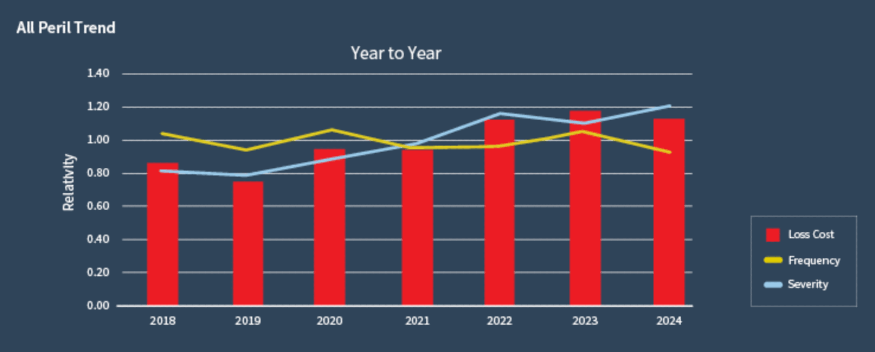
All peril trend year over year. Courtesy of LexisNexis® Risk Solutions.
All peril trend year over year. Courtesy of LexisNexis® Risk Solutions.
LexisNexis® report shows rising home insurance peril severity
ColoradoBiz Staff //December 10, 2025//



ATLANTA – LexisNexis® Risk Solutions has released its 10th annual LexisNexis U.S. Home Trends Report, providing an updated analysis of by-peril claims trends in the U.S. home insurance industry to help carriers make more informed, strategic decisions. Examining loss cost and claims frequency and severity, the report also offers insights into seasonality shifts, catastrophic claims and geographic patterns, including trends by U.S. state.
In Brief:
- All Peril severity reached a seven-year high, rising 9% in 2024
- Catastrophic claims made up 42% of all claims and 64% of losses
- Wind and hail perils drove major increases in loss costs nationwide
- Climate disasters and inflation continue to fuel rising home insurance risk
Key Takeaways
- All Peril severity increased 9% between 2023 and 2024, the highest in seven years, with 2024 breaking records set in 2023 as the U.S. experienced 27 climate disasters with $1 billion or more in damages, and 21% above the long-term average. All Peril loss cost was 49.7% higher in 2024 than in 2019.
- Catastrophe claims represented 42% of claims across all perils combined in 2024, while catastrophe losses increased to 64%, another seven-year high signaling the growth of catastrophic events driving overall loss trends.
- Wind claims surged in 2024, with severity up 23.5% and loss costs jumping 30.7%, fueled by Hurricanes Helene and Milton – two of the costliest events of the year[i]. Losses peaked in September last year, the height of hurricane season.
- Hail loss costs was 19% above the seven-year average in 2024 and nearly two-thirds of claims deemed catastrophic. Loss cost for other weather-related perils declined across Fire and Lightning (down 3%) and Non-Weather-Related Water (down 4.3%) from 2023 to 2024, while Weather-Related Water rose 25.4%.
“U.S. home insurers are facing two converging challenges: climate-driven catastrophes intensifying and inflation continuing to drive up repair and replacement costs,” said George Hosfield, vice president, home insurance, LexisNexis Risk Solutions. “These pressures are helping to contribute to higher premiums for U.S. consumers as carriers work to manage rising loss costs. The data shows just how critical it is for the insurance industry to leverage more advanced analytics to help anticipate risk and maintain resilience. Last year, catastrophe claims accounted for nearly two-thirds of all losses, which was the highest level we’ve seen in the seven years included in this year’s study.”
All Peril Trends
- The U.S. home insurance industry has experienced an upward trend in loss cost across all perils combined over the past seven years.
- Severity reached its highest level in seven years in 2024, increasing 21% above the long-term average, likely driven by sustained inflationary pressures across all perils. While severity is high, frequency declined from 2023 to 2024 by 11.6%.
- Colorado ranked highest in loss cost from catastrophic claims, while Nebraska had the highest loss cost of All Peril claims combined in 2024, driven by Hail losses. U.S. states with the highest combined catastrophe and non-catastrophe loss costs include Colo., Minn., Neb., La. and S.D. The lowest ranking states include Nev., N.H., W. Va., Vt. and Maine.
Hail Perils
- In 2024, the U.S. experienced 5,373 hail events, down from 2023[ii], but the loss costs continued their upward trend, sitting 19% above the seven-year average.
- The U.S. experienced 11 severe weather/hail events with the cost of hail damage exceeding $3 billion per annum – up from less than $500 million in the last 24 years[iii].
- States with the highest impact of hail-related perils include Colo., Neb. and Kansas. In 2024, the highest loss cost peril in Texas was hail over other weather events.
- Hail peril seasonality over the past seven years continues, with April, May and June observing the highest frequency and loss cost.
Wind, Water, Fire and Lightning Perils
- Wind peril frequency rose 5.8%, along with loss cost increasing 30.7% from 2023-2024. Severity increased 23.5% year over year.
- Fire and Lightning perils in 2024 saw decreases across loss cost (-3%) and frequency (-13.5). However, severity increased 12.2% in 2024, likely due to major fires in New York, Connecticut and New Mexico[iv]. Catastrophic claims made up 10% of claims in 2024.
- In 2024, there were 91 flash flood emergencies, a record-breaking number since 2003[v], causing an increase in loss cost. Weather-Related Water loss costs increased 25.4% from 2023 to 2024, with claims severity up 29.6%, while claims frequency declined 3.2%. Oregon recorded the highest loss cost due to a severe winter storm with strong winds and freezing temperatures that led to burst water pipes[vi]. In 2024, 64% of weather-related water claims were catastrophic.
Non-Weather-Related Perils
- Addressing claims related to water damage, such as leaking pipes and appliances, Non-Weather-Related Water perils decreased across loss cost (-4.3%) and frequency (-9.9%) while severity increased (6.2%) in 2024.
- Theft loss cost and frequency decreased by 20% and 20.9%, respectively, in 2024, and severity rose by 1.1%, partially attributed to the rising cost of consumer goods such as high-end appliances and kitchenware[vii].
- Liability loss cost increased 5.5% along with severity (18.8%) in 2024, while frequency decreased by 11.2%.
- Other Perils, including physical damage claims not included elsewhere, extended coverage, damage to property of others, etc., saw a severity increase of 2.4% year over year. Loss cost, along with frequency, both declined 24.6% and 17.3%, respectively, from 2023 to 2024.
“The sharp rise in severity across multiple perils highlights the need for carriers to think beyond short-term rate actions,” continued Hosfield. “Carriers that leverage more advanced property data insights–from roof condition to water damage risk–can make more informed underwriting decisions and stand a better chance of weathering the storm even as climate volatility and inflation continue to pressure the market.”
Download the latest LexisNexis U.S. Home Trends Report.
[i] Adam B. Smith, “2024: An active year of U.S. billion-dollar weather and climate disasters,” National Oceanic and Atmosphere Administration (NOAA) Climate.gov, https://www. climate.gov/news-features/blogs/beyond-data/2024-active-year-us-billion-dollar-weather-and-climate-disasters
[ii] “Facts + Statistics: Hail,” Insurance Information Institute, 2025, https://www.iii.org/fact-statistic/facts-statistics-hail
[iii] “Hail Statistics by State,” YPA Public Adjusters, https://www.ypapublicadjusters.com/hail-statistics-by-state/
[iv] Hristina Byrnes, “Year In Review: The 25 Biggest Wildfires of 2024,” Climate Crisis 247, https://climatecrisis247.com/gallery/year-in-review-the-25-biggest-wildfires-of-2024/
[v] Mary Gilbert, “An unprecedented number of flood emergencies have ravaged the US. It’s a warning of what’s to come,” CNN, https://www.cnn.com/2024/10/25/weather/recordnumbers-of-an-extreme-warning-show-the-reality-of-climate-change
[vi] Lillian Karabaic, Joni Auden Land and Courtney Sherwood, “Cold weather, power failures continue in aftermath of Oregon storm,” Oregon Public Broadcasting (OPB), https:// www.opb.org/article/2024/01/14/winter-storm-ice-snow-deaths-power-failures-portland-oregon-willamette-valley
[vii] Whizy Kim, “The surprising reason luxury goods are booming,” Vox, https://www.vox.com/money/23728283/luxury-designer-boom-nike-lvmh-pandemic-le-creuset
i