Upcoming Event
 Free Newsletter

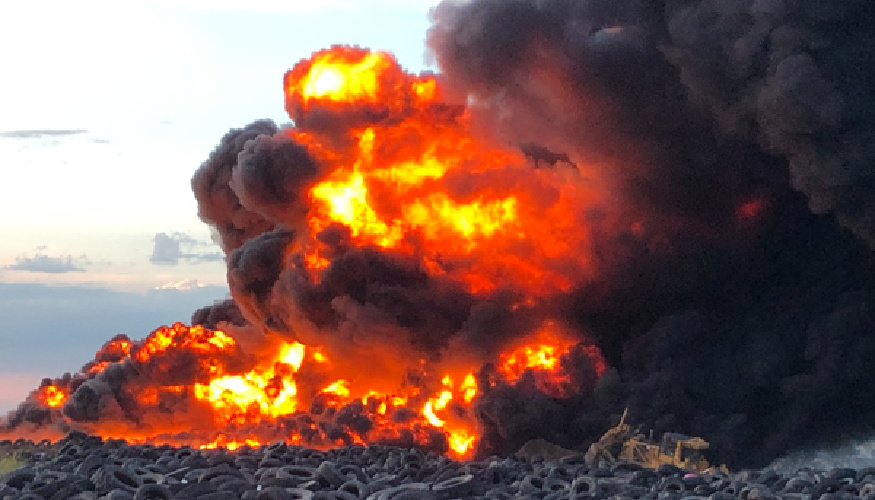
Photo courtesy of Platteville-Gilcrest Fire Protection District.
Photo courtesy of Platteville-Gilcrest Fire Protection District.
Tire mountain and Colorado’s waste tire recycling challenges
Eric Peterson //April 21, 2026//



This article appeared in the Spring 2026 issue of ColoradoBiz titled “Tire Mountain: Colorado’s Recycling Conundrum.”
In 2020, a tire fire broke out in Hudson, Colorado, about 30 miles northeast of Denver. Not just any tire fire, mind you: It was a tire fire at the largest tire dump in the United States.
In Brief:
- Tire mountain holds around 40 million tires northeast of Denver
- Senate Bill 24-123 extends monofil closing date to 2034
- Pretred wins $11.2 million grant to expand tire recycling in Aurora
- Tires to Green Recycling handles only 1.5 million of 5 million tires annually
The Hudson tire monofil, a.k.a. Tire Mountain, is home to around 40 million tires. It’s the last major tire monofil open in the state. The former owner, CH2E, sold the monofil to Tire Mountain LLC in 2023 for $550,000.
As program manager for the solid waste program at Colorado Department of Public Health and Environment (CDPHE), David Snapp has worked on the state’s waste tire issue for more than a decade. He’s optimistic that Tire Mountain could start to shrink in the near future.
“They just obtained a new permit,” says Snapp. “We’re waiting to see what kind of recycling they want to do at that site.”
Enacted two years ago, Senate Bill 24-123 extended the monofil’s mandated closing date for another 10 years to 2034, among other things. “It basically took the waste tire end user fund and made that an enterprise, so now there’s an enterprise board that’s going to set the end user tonnage rates,” says Snapp.
Of the $2 fee the state now charges per new tire (up from 50 cents in 2025), $1.50 goes to enterprise board activities. “They’re going to do other things, like create a grant program for equipment and infrastructure for recycling facilities,” explains Snapp. “They are going to develop a marketing program for waste tire end uses.”
The ultimate goal is not only to recycle the tires discarded that year but also start mining Tire Mountain, he adds. “Hopefully, we’ll start to see tires come out of the Hudson monofil as a result of all the work that they’re doing to prop up a new waste tire end user program.”
Next door to Tire Mountain, Tires to Green Recycling (T2GR) CEO Ildefonso Roman Navarro says he’d like to help downsize Tire Mountain. T2GR was instrumental in the cleanup of the Midway monofil near Fountain.
Hudson is another story. “There’s nothing going on there,” says Navarro. “It’s completely abandoned.”
The website for Tire Mountain highlights pyrolysis, or oxygen-free burning, to convert tires into a variety of feedstocks and fuels for industrial use. Critics of pyrolysis say the process is too energy-intensive and high-emission to be viable. (The owners of Tire Mountain did not respond to multiple requests for an interview.)
Even if T2GR were able to work with the new owners, the economics don’t pencil out, he adds. “Our operation depends only on the fresh incoming tires from haulers and from our logistics operation. Really, we cannot do anything with that monofil.”
Navarro estimates the cleanup would cost about $5 million, but there’s little profit motive for T2GR or anyone else. “Somebody already collected the tipping fees. It’s useless for us to take tires from those pits,” he says. “The haulers charge most of the money, and sometimes we don’t know where they drop the tires.”
Navarro says T2GR could handle every waste tire in Colorado, about 5 million a year. “We’re getting maybe 1.5 million,” says Navarro. “I don’t know where they go, but they aren’t coming to us.”
Even if they were going to T2GR, there’s a problem on the demand side as well. Tire-derived fuel (TDF) is used in concrete kilns, but other end-use products like crumb rubber, rubber mulch, and carbon black are much smaller niches, and shipping costs often eclipse profit.
“There’s no market,” says Navarro. “Our main customer is a great cement company, GCC, which is in Pueblo, but they take from us 800 or fewer tons per month of TDF when they are open, because they have technical closures. And when they have technical closures, they stop buying from us.”
Another Wyoming cement company, Mountain Cement, has inked a contract with T2GR for 500 tons per month. Between the two contracts, that’s only about a quarter of the state’s annual waste tire generation.
Navarro says T2GR has invested about $40 million in its facility since 2012. “And we’re not even breaking even,” he notes. “Last year, we lost $100,000, but we were losing $500,000 each year, so now we may be getting close to the break-even point, but, but it’s been really, really tough… . We need to invest another $1.5 million, give or take, to put another line to produce mulch. And nobody wants to lend us money because of the type of business. It’s been really maddening.”
A lack of government support hasn’t helped, adds Navarro. He says T2GR has applied for grants from the Colorado Circular Communities (C3) program three times without success.
Another local tire-recycling company, Pretred, won an $11.2 million grant from C3 in 2025. Pretred makes road construction barricades from waste tires; T2GR doesn’t supply the company with raw materials. “They don’t take tires from us,” says Navarro. “First and foremost, they should make it mandatory that these people take the product from the local companies.”
Toni Olson, director of marketing and government affairs at Aurora-based Pretred, says that the company’s supply chain will soon include waste tires from Colorado. “Those funds are expanding our processing operations,” says Olson, citing a plan to bring crumb rubber capability in-house. “We’re in the process of negotiating contracts to get those Colorado tires, which we’ll begin processing. Ultimately, our goal is to attack the monofil. We would love to start pulling tires out of there and turning them into our sustainable circular products.”
In Q2 2026, Pretred will move to a new facility at Denali Logistics Park in Aurora. Olson says the company plans to expand from 29 to 55 employees in the new facility as it triples its capacity to about 4 million tires annually.
Pretred’s highway barriers are recyclable, and the company’s process recycles 100% of the tire, she notes. The current status quo isn’t remotely circular. “They are being either incinerated or sent to landfill as alternative daily cover,” says Olson.
One 16-foot barrier from Pretred is made of about 75 tires, she adds, and one mile barrier reduces carbon emissions by 2,750 tons. “Not only are you recycling the tire waste and diverting that from landfill or burning, but now you’re also offsetting having to make the concrete.”
Rick Welle, vice president of Pretred and a related company, RubbErosion, says the out-of-state supply chain for both companies is based on infrastructure. “Essentially, there’s no one in the state of Colorado that produces crumb rubber,” he explains. “There have been a handful of companies that have attempted it, and we’ve tried to utilize them as best as we can, but there have been issues with overall production and volumes, and consistency of the product, consistency of volume.”
The same problems have plagued tire recyclers for decades. “I’ve been in tire recycling essentially my whole life,” says Welle, who cut his teeth in the industry at his father’s former company, Sedalia-based Front Range Tire Recycle. “Working in the family business, we picked up tires, we ground tires. We could do that all day long, every day of the week, but what do we do with the grindings at the end of the day? It was a lack of end-use markets.”
That dynamic led Welle to co-found RubbErosion in 2013. Soon thereafter, Eric Davis, now president of Pretred, approached Welle about another startup. In 2020, the pair co-founded Pretred. RubbErosion now recycles 300,000 to 500,000 tires annually, and the two companies recycle more than 1.5 million combined.
Welle is currently serving on the nine-member Waste Tire Management Enterprise Board, established in 2024 by SB24-123. “The high-arching goal of the board is to find circularity in our products that can be manufactured or produced from whole scrap tires,” he says.
“The biggest focus that we have right now is the end-user program. The end-user program is a very integral program in our state right now that really helps private businesses haul the tires to the right locations, have the locations process the tires in a safe and environmental fashion, and then create the markets.”
The board is also developing a grant program to incentivize recycling, he adds. “How can we help promote more innovative technologies and ideas and concepts moving forward?”
State funding is a necessity for a robust tire recycling ecosystem, and previous lapses in the state’s tire cleanup fund in 2008-09 and 2018-19 had predictable results. “If the governor has to sweep funds, that’s a killer to our market,” says Welle. “You’ll start seeing tires piled up even in the Denver metro area the day after funds are swept.”
“I think our program has had a lot of success,” says CDPHE’s Snapp. “When you look at being well over 100% for a couple of those years, we did see a lot of positive progress at facilities that were removing tires from stockpiles. You see that bump up because the end-user program came back in 2020. In 2018 and 2019, the end-user program had gone away, so nobody was being reimbursed for end-using tire products.”
Robust funding for reimbursement will be key to finding end uses for tens of millions of waste tires.
Navarro points to T2GR’s work at the since-closed Midway monofil near Fountain. “We cleaned it up,” he says. “That had around 30 million tires. It’s already completely cleaned and closed.”
T2GR could do the same thing in Hudson, adds Navarro, but not without more help from the public sector. “The cost of transportation has skyrocketed. From Hudson to Pueblo, it’s 150 miles one-way, 150 miles back, so you need to put 300 miles on a truck to deliver 25 tons of TDF, which we sell for $50 a ton.”
“We have no support. We need support, at least for transportation,” says Navarro. “The problem actually is theirs, not ours, because one day we say we are fed up, we close, and the state is going to have a huge, huge, huge problem.”
Online:
- Tire Mountain: www.tiremtn.com
- Tires to Green Recycling: www.t2gr.com
- RubbErosion: www.rubberosion.com
- Pretred: www.pretred.com
The annual Tire Recycling Conference is taking place May 12–14, 2026, in Denver. Visit www.tirerecyclingfoundation.org for more information.
Sidebar: Startup Spotlight: Recycled Rubber Designs
Olive Collier and Maslin Mellick, co-founders of Recycled Rubber Designs, spun the company out of a project for their master’s program in architecture at the University of Colorado Denver with a concept for exterior tiles made from recycled tires. Tire Mountain provided the original impetus for the project. “We were a bit shocked to discover that, and it inspired us to come up with a project around that Hudson tire monofil,” says Mellick.
In 2023, the Colorado Green Building Guild awarded them for sustainable innovation, and the duo garnered media attention, but finding a contract manufacturer has proven difficult. “To get something molded from rubber through a third party was really difficult,” says Mellick. “Even trying to get a prototype made using a thermal mechanical press was really difficult.”
Adds Collier: “As architects, we know the challenges that go into meeting requirements for building materials, so now working on the other side for a company trying to get to that standard has been very eye-opening for us.”
Both Collier and Mellick have since graduated and are practicing architects, and the startup is a side hustle they hope to launch products from in the future. “We most recently have been studying exterior furniture, just because of the durable properties,” says Collier. “That’s our new avenue, but we’ve really tried to keep open-minded as designers.”
o