Upcoming Event
 Free Newsletter

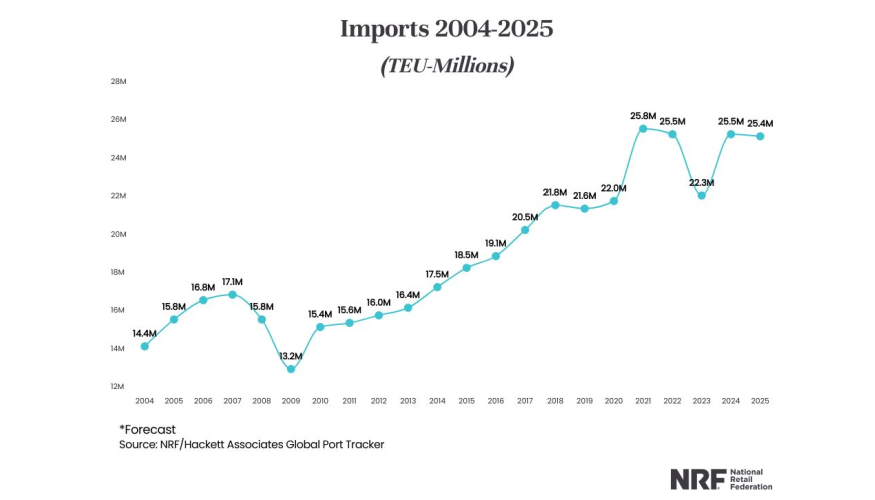
Imports 2004-2025. Courtesy of NRF/Hackett Associates Global Port Tracker
Imports 2004-2025. Courtesy of NRF/Hackett Associates Global Port Tracker
US container imports expected to fall in early 2026
ColoradoBiz Staff //March 9, 2026//



Imports at major U.S. container ports are expected to remain below last year’s levels during the first half of 2026 as tariff uncertainty continues, though it is too early to determine any impact from the conflict in Iran, according to the Global Port Tracker report released Monday by the National Retail Federation and Hackett Associates.
In Brief:
- U.S. container imports are expected to remain below 2025 levels during the first half of 2026 amid ongoing tariff uncertainty.
- The Supreme Court struck down tariffs under the International Emergency Economic Powers Act, prompting new tariff actions.
- Analysts say the Iran conflict has not yet affected U.S.-bound container cargo volumes.
- Imports totaled 2.08 million TEU in January, down 6.4% year over year, with first-half volumes forecast to fall 2.5%.
“The Supreme Court has struck down IEEPA tariffs but other tariffs have already been announced and others will be coming, so uncertainty continues for retailers,” NRF Vice President for Supply Chain and Customs Policy Jonathan Gold said. “Tariffs drive up costs for businesses and prices for consumers. They should be used in a strategic manner.”
Last month, the Supreme Court ruled against the administration’s use of tariffs under the International Emergency Economic Powers Act. President Donald Trump responded by announcing a temporary 150-day 10% tariff under Section 122 of the Trade Act of 1974. The administration later said the rate could increase to 15% and is also considering new Section 301 trade investigations.
Hackett Associates Founder Ben Hackett said it is too early to see any effect on U.S. container imports from the conflict in Iran that began just over a week ago.
“The immediate impact on containerized traffic to the United States is not likely to be substantial since little U.S.-bound container cargo is sourced from the region,” Hackett said. “Increasing oil and gasoline prices could drive inflation if the conflict persists and squeeze consumer spending.”
Ports tracked by the report handled 2.08 million twenty-foot equivalent units in January, up 3.8% from December but down 6.4% from a year earlier. The ports of New York and New Jersey and Miami had not yet reported January data.
February imports are projected at 2.01 million TEU, down 1.3% year over year. March is forecast at 1.91 million TEU, down 11.2%. April is expected to reach 2.03 million TEU, down 8.1%. May is forecast at 2.09 million TEU, up 7%, followed by 2.1 million TEU in June, up 6.8%, and 2.2 million TEU in July, down 8%.
The projections would bring total imports for the first half of 2026 to 12.21 million TEU, down 2.5% from 12.53 million TEU during the same period in 2025. Increases projected for May and June reflect a sharp decline in imports during those months last year after tariffs were announced in April 2025, disrupting trade.
Total imports during 2025 reached 25.4 million TEU, down 0.3% from 25.5 million TEU in 2024.
-