
Upcoming Event
 Free Newsletter

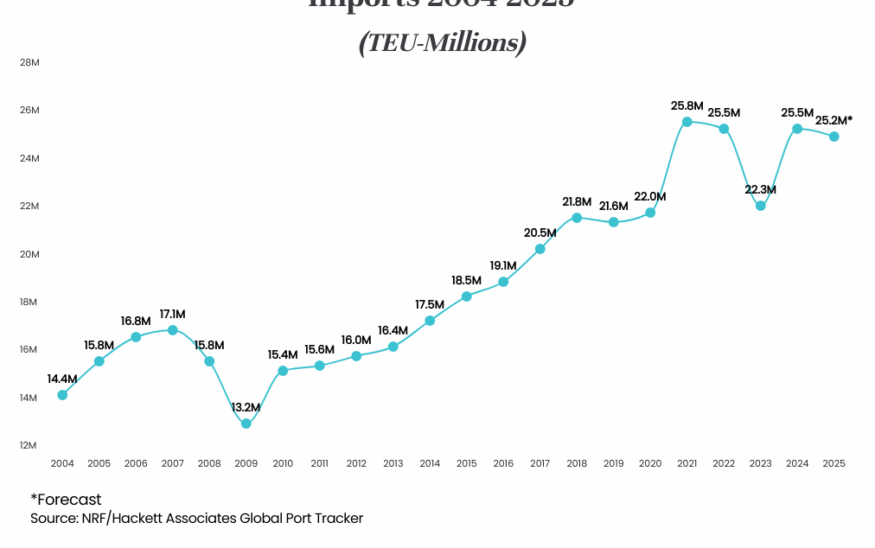
December 2025 annual port tracker chart. Courtesy of National Retail Federation.
December 2025 annual port tracker chart. Courtesy of National Retail Federation.
U.S. import cargo declines expected to continue into 2026
ColoradoBiz Staff //December 10, 2025//



WASHINGTON — Import cargo volumes at major U.S. container ports are expected to keep falling into 2026 as tariffs and trade policy uncertainty continue to weigh on global shipping, according to the latest Global Port Tracker report released by the National Retail Federation and Hackett Associates.
In Brief:
- Import cargo volumes projected to decline into 2026
- Tariffs and trade uncertainty continue to weaken demand
- Holiday sales forecast to top $1 trillion despite slowdown
- November and December expected to be slowest months since 2023
“Stores are stocked up and ready for a record holiday season but there is still a great deal of uncertainty about what will happen in 2026 with trade policy,” said Jonathan Gold, NRF vice president for supply chain and customs policy. “Regardless of what develops, retailers will adjust their supply chains accordingly and strive to ensure that consumers have affordable options when they shop.”
The administration recently reduced tariffs on certain food products, but the future of other tariffs imposed under the International Emergency Economic Powers Act depends on a Supreme Court challenge. Even if those tariffs are overturned, officials are expected to pursue reinstatement under other trade authorities.
Ben Hackett, founder of Hackett Associates, said rising tariffs will continue to affect global trade patterns. “We are seeing the results of the tariffs in weakening cargo demand going forward from the fourth quarter of this year and likely into the first half of next year,” Hackett said. “Container shipping rates are already declining on both coasts due to less need for cargo space for goods from both Asia and Europe.”
The outlook comes as NRF projects holiday sales will surpass $1 trillion for the first time, an increase of 3.7 to 4.2 percent over 2024.
U.S. ports covered by Global Port Tracker handled 2.07 million Twenty-Foot Equivalent Units in October, though Charleston has not yet reported. The total was down 1.8 percent from September and 7.9 percent from a year earlier.
Global Port Tracker expects November volume to reach 1.91 million TEU, down 11.6 percent year over year, and December to total 1.86 million TEU, down 12.7 percent. December would be the slowest month since June 2023. Both months are traditionally soft, but last year’s volumes were inflated by concerns over potential port strikes. Retailers also imported goods early this year to avoid tariffs, contributing to the year-over-year declines.
The first half of 2025 resulted in 12.53 million TEU, up 3.7 percent from the same period in 2024. The full year is forecast at 25.2 million TEU, 1.4 percent below 2024’s 25.5 million.
Cargo volume is expected to rise month over month in January for the first time in six months with a projected 2 million TEU, though that figure would still be down 10.3 percent year over year. February is forecast at 1.86 million TEU, down 8.5 percent; March at 1.79 million TEU, down 16.8 percent; and April at 1.97 million TEU, down 10.9 percent.
Global Port Tracker, produced for NRF by Hackett Associates, tracks historical data and forecasts for major U.S. container ports on the West Coast, East Coast and Gulf Coast. The report is free for NRF members. Subscription information is available at NRF.com/PortTracker or globalporttracker.com.
NRF provides economic analysis for the retail industry and publishes regular reports on factors affecting trade and supply chain conditions.
i