Upcoming Event
 Free Newsletter

State of the state: Colorado weighs future of data centers amid AI-driven demand
Eric Peterson //December 10, 2025//
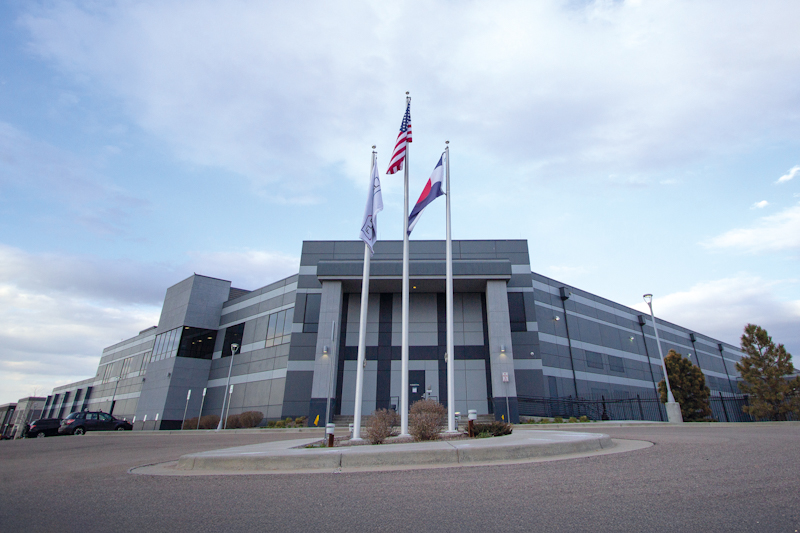
Flexential's Denver-Englewood headquarters. Courtesy of Flexential.
Flexential's Denver-Englewood headquarters. Courtesy of Flexential.
State of the state: Colorado weighs future of data centers amid AI-driven demand
Eric Peterson //December 10, 2025//



This article appeared in the Winter 2025 issue of ColoradoBiz under the headline, State of the State: The future of data centers in Colorado.
The AI boom (or bubble, depending on who you ask) is driving demand for ever-larger data centers.
In Brief:
- AI boom drives massive electricity and water demand for data centers
- Colorado lags behind neighboring states in attracting hyperscale projects
- Flexential cites state policies and transmission limits as key barriers
- Energy experts say natural gas could help meet data center power needs
Known as “hyperscale” data centers, these multibillion-dollar facilities typically house thousands of servers and often consume more than 100 megawatts of electricity annually, roughly the same as a city of 50,000 people.
Based on AI’s processing needs, experts anticipate a massive spike in electricity demand in the near future. According to Boulder-based environmental advocacy group Western Resource Advocates, it will increase by 50% in the interior West over the coming decade, with a projected 55% increase in Colorado, driven by a massive need for water for cooling.
The Rocky Mountain region has already been a target for hyperscale data centers, with Utah, Wyoming and Arizona attracting more hyperscale projects than Colorado. Critics say Colorado needs to do more to incentivize the industry to build here, while many environmental advocates say it’s no big loss.
Centennial-based Flexential operates 42 data centers across 18 markets, connected via a national network. Three of Flexential’s data centers are in Colorado, with a fourth under construction in Parker. The 900-employee company is focused on the wholesale market with data centers that are typically about 20 or 30 megawatts.
“We feel that we’re going to continue to hit right down that fairway,” says Flexential CEO Ryan Mallory. “It’s a really unique platform that services a segment in the market that’s underserved right now, with everybody going after these large-scale, multi-100-megawatt campuses or gigawatt campuses.”
Flexential’s multi-tenant model, rather than targeting single companies like Meta or Alphabet, is more resilient, he adds. “We feel very comfortable with a very diverse customer base,” says Mallory. “Our business model is we build in 36 megawatt chunks, not 300 megawatt chunks.”
“We’re focused on a diverse customer base. These companies that are out there are focusing on four or five customers, investing billions, if not tens of billions of dollars, into the ground. That’s a big bet.”
Notes Mallory, “There will be a correction at some point. There always is anytime any market gets frothy.”
Regardless, Mallory says state policy has been a roadblock to Flexential in Colorado. “We’ve recently walked away from a very large campus which would have brought a lot of benefits to a rural community because of the state-level policies that are in place around the need to have renewable offsets and just how difficult that is to get because of some of the permitting requirements that that exist at the state level to get the transmission lines put in,” he says. “There’s a lot of renewable generation in solar farms and wind farms on the Eastern Plains, but you can’t get it to the Denver Metro or the I-70 corridor. [The transmission infrastructure] just doesn’t exist. We were quoted $2 billion to build that out. We’re not a power company.”
“It would have been an incredible partnership for us,” Mallory laments. “If I’m spending $500 million to build a data center, the companies that are coming in are spending somewhere between six to eight times that much in the equipment they’re putting in there. All of that brings tax revenue to those local communities and at the state level as well. And so it’s just unfortunate that Colorado isn’t partnering with the technology companies as much as some of the other states that are directly adjacent to Colorado, or the other states we operate in.”
Flexential “diverted those development dollars to Texas and Georgia,” he adds. “It’s absolutely creating a windfall for states that are around Colorado, and it’s unfortunate we’re headquartered here. We are putting in our fourth data center, but we’ve diverted a lot of our development resources to other states because Colorado has made it clear that there are different priorities other than increasing the tax base from technology resources at a state level.”
Matthew Gonzales, executive director of the Houston-headquartered Consumer Energy Alliance’s southwest region, says natural gas is a good fit for the energy needs of data centers, and Colorado should leverage this natural resource to lure more data centers to the state.
“The big setback that I would say Colorado has is that there’s somewhat of a negative approach towards natural gas,” says Gonzales. “There was even legislation last cycle to essentially stop natural gas development by 2030, so that type of policy is not good when you’re trying to bring in data centers and AI. They need good base load power. And let me be clear: I’m a big supporter of solar and wind, but there’s not enough solar and wind on the grid to meet the energy demand that comes from these data and AI centers, so we’ve got to make sure that we have a good, healthy mix.”
“Wyoming has been a great example,” says Gonzales. “Arizona just announced that they’re bringing a pipeline from the Permian Basin in Texas that’s going to provide natural gas and base load power generation for them to try to leverage more of these data and AI centers.”
The data center industry’s water needs could be lessened with drilling byproducts, he adds. “States like New Mexico are looking at the utilization of things like produced water. There’s a lot of produced water and oil and gas operations,” notes Gonzales. “Being able to use it on some of these other processes, particularly like data centers and AI, would be huge. It actually alleviates a lot of the pressure on freshwater. We’ve got to be innovative.”
Naysayers point to a potential bubble to end all bubbles inflating around AI. Investors have poured more than 15X the funding into AI compared to that of Internet startups before the dotcom bubble burst in 2001, as many AI companies struggle to find paths to profitability. An August 2025 report from MIT found that a staggering 95 percent of AI initiatives at organizations were generating no returns.
These and other similar data points beg the question: Why incentivize an industry that’s struggling to find its footing? Are there homegrown companies in Colorado that are showered with tax credits and friendly policies?
Online:
Flexential: www.flexential.com
Consumer Energy Alliance: www.consumerenergyalliance.org
Western Resource Advocates: www.westernresourceadvocates.org