Upcoming Event
 Free Newsletter

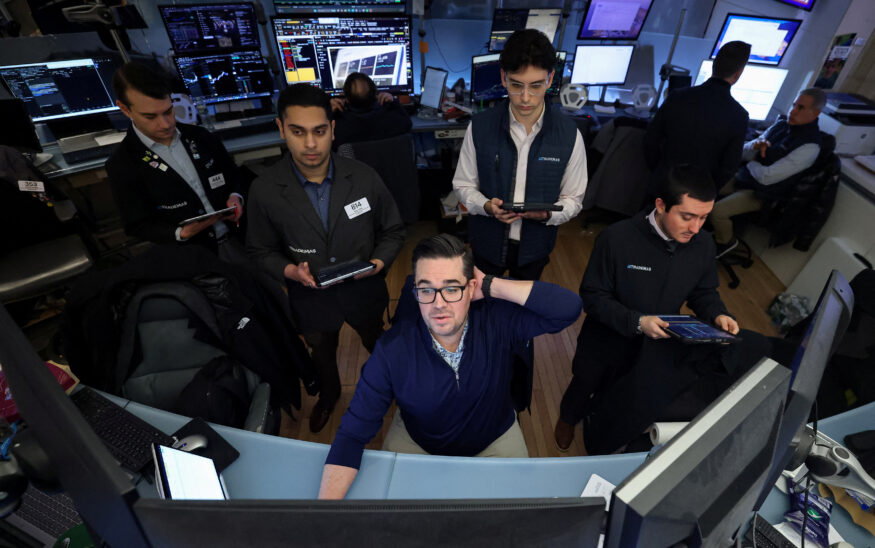
Traders work on the floor at the New York Stock Exchange (NYSE) in New York City, U.S., January 13, 2026. REUTERS/Brendan McDermid
Traders work on the floor at the New York Stock Exchange (NYSE) in New York City, U.S., January 13, 2026. REUTERS/Brendan McDermid
Dow ends lower after volatile week as Intel outlook weighs
David French
Reuters //January 23, 2026//



(Reuters) – The Dow Jones Industrial Average finished down on Friday, while the S&P 500 ended largely unchanged, as investors’ risk appetite was dimmed at the end of a topsy-turvy week by Intel’s plunge on a downbeat outlook.
In Brief:
- The Dow fell Friday as Intel’s outlook pressured market sentiment
- S&P 500 ended little changed while the Nasdaq posted modest gains
- Wall Street benchmarks still recorded weekly declines
- Investors turned focus to upcoming tech and Magnificent Seven earnings
All three Wall Street benchmarks had rebounded in the past two sessions following Tuesday’s sharp selloff triggered by U.S. President Donald Trump’s threats to impose tariffs on European allies, an effort to pressure them into accepting his claim to Greenland.
On Friday, the Dow Jones Industrial Average fell 285.30 points, or 0.58%, to 49,098.71. The S&P 500 edged up 2.26 points, or 0.03%, to 6,915.61, and the Nasdaq Composite gained 65.23 points, or 0.28%, to 23,501.24.
Even the Nasdaq’s Friday gains were not enough to rescue the benchmarks from having a down week, with the S&P 500 off by 0.36%, the Dow lower by 0.53% and the Nasdaq slipping by 0.06%.
Despite the week’s limited pullback, investors appeared to remain confident that, while geopolitical-induced volatility is a present danger, the overall state of the American economy remains robust.
“When we think about what it means from an investor’s standpoint, we feel pretty good about where we are today,” said Jason Blackwell, chief investment strategist at Focus Partners Wealth.
He noted that volatility was expected this year, given the midterms later in 2026. However, corporate earnings are expected to remain strong, and the economy is going along fine.
“We’re feeling pretty good, but mindful we might have some significant twists and turns throughout the rest of the year,” Blackwell added.
The ‘Show-Me’ Season
One twist on Friday that weighed on market sentiment was Intel. Its shares sank 17% after the company forecast quarterly revenue and profit below market estimates, saying it struggled to satisfy demand for its server chips used in AI data centers.
With many technology and semiconductor companies still trading at sky-high valuations, 2026 is viewed by many as the year when the huge excitement for the artificial intelligence trend and the huge capital expenditures to achieve it will start showing up as corporate revenue.
Julian McManus, portfolio manager on the Global Alpha Equity team at Janus Henderson, noted that last week’s earnings from TSMC, the world’s leading producer of advanced AI chips, could bode well for the latest earnings in the space.
“Going into results, we’re going to be in a ‘show-me’ period, where you have to actually put up the revenue growth to justify the run-up in stocks,” he said. “It’s going to be a period of the haves versus the have-nots, and I personally don’t see Intel being in the haves.”
Mag 7 Earnings Test
This show-me point will be particularly pertinent for investors next week, with earnings on deck from many of the so-called Magnificent Seven stocks, including Apple, Tesla and Microsoft.
On Friday, most of the megacaps rose, with Microsoft, Meta and Amazon up between 1.7% and 3.3%. Nvidia gained 1.5% after Bloomberg News reported Chinese officials have told Alibaba, Tencent and ByteDance they can prepare orders for Nvidia’s H200 AI chips.
Of the S&P sub-sectors, seven ended in positive territory, led by the 0.9% increase in materials.
The energy index rose 0.6% on Friday, to its third successive record closing high. It was also the top-performing sub-index for the week, while its 10.1% advance so far in 2026 is unmatched.
The number of shares changing hands on U.S. exchanges on Friday was 17.34 billion shares, compared with the 17.07 billion average over the last 20 trading days.
(Reporting by Sruthi Shankar and Pranav Kashyap in Bengaluru and David French in New York; Editing by Krishna Chandra Eluri and Aurora Ellis)
P