Upcoming Event
 Free Newsletter

US core capital goods orders rise with largest shipment gain amid AI boom
Lucia Mutikani
Reuters //July 27, 2026//
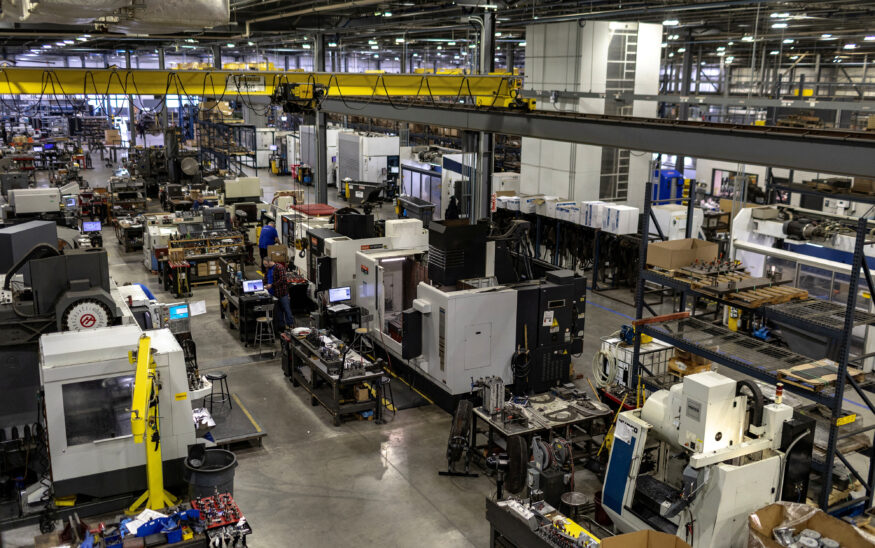
The production floor of the General Stamping & Metalworks building in South Bend, Indiana, U.S., March 23, 2026. REUTERS/Jim Vondruska/File Photo
The production floor of the General Stamping & Metalworks building in South Bend, Indiana, U.S., March 23, 2026. REUTERS/Jim Vondruska/File Photo
US core capital goods orders rise with largest shipment gain amid AI boom
Lucia Mutikani
Reuters //July 27, 2026//



WASHINGTON (Reuters) – New orders for key U.S.-manufactured capital goods increased strongly in June while shipments surged by the most in 4-1/2 years as businesses ramped up spending on artificial intelligence, suggesting the economy maintained a fairly strong pace of growth in the second quarter.
The Commerce Department report on Monday also showed upward revisions to May data. The AI build-out is helping to limit the drag on the economy from the five-month war in the Middle East and the Trump administration’s lingering tariffs on imports, propping up manufacturing.
The broad increase in the so-called core capital goods orders and shipments last month was driven by robust demand for computers and electronic products, as well as electrical equipment, appliances, and components.
“Equity markets are still wrestling with the valuations of many of these tech companies, but one thing is certain, and that is the capex expenditures of corporate America are keeping the economy afloat despite caution in other sectors engendered by the Middle East war uncertainty and higher energy prices,” said Christopher Rupkey, chief economist at FWDBONDS.
Non-defense capital goods orders excluding aircraft, a closely watched proxy for business spending, rose 0.9% last month after an upwardly revised 1.9% increase in May, the Commerce Department’s Census Bureau said. Economists polled by Reuters had forecast core capital goods orders would advance 0.8% after a previously reported 1.4% jump in May.
Core capital goods orders rose 9.3% year-on-year in June.
Orders for computers and electronic products soared 3.1% after rebounding by 1.2% in May. Electrical equipment, appliances and components orders rose 0.9% after climbing 0.2% in May. Orders for primary metals advanced 1.1%, but bookings for fabricated metal products fell 0.5%.
Machinery orders dipped 0.1%. Shipments of core capital goods, which go into the calculation of the business spending on equipment component in the gross domestic product report, surged 1.9% last month after gaining 0.2% in May.
The largest advance in shipments since December 2021 was led by computers and electronic products, and machinery. There were solid increases in the shipments of electrical equipment, appliances and components, as well as primary metals.
Nondefense capital goods orders increased 1.2% and shipments of these goods rose 1.5%.
Stocks on Wall Street were trading higher as a pause in hostilities between the U.S. and Iran pushed oil prices lower. The dollar was steady against a basket of currencies. U.S. Treasury yields were mostly lower.
Double-Digit Growth Expected for Equipment Spending
The government is scheduled to publish its advance estimate of second-quarter GDP growth on Thursday. A Reuters survey of economists estimated the economy grew at a 2.1% annualized rate last quarter, which would match the first quarter’s pace and fit in with the Federal Reserve‘s narrative of resilience.
The U.S. central bank is expected to leave its benchmark overnight interest rate in the 3.50%-3.75% range on Wednesday, though a few economists believe an increase in borrowing costs could not be ruled out.
Other economists argued the AI-driven strength in equipment spending was a double-edged sword for the Fed.
“On one side, strong capex supports economic activity and productivity,” said Priscilla Thiagamoorthy, a senior economist at BMO Capital Markets. “On the other, Fed officials have recently noted that the ongoing boom in AI-related investment may sustain inflationary pressures.”
Economists expected another quarter of double-digit growth in business spending on equipment.
“The robustness is not limited to the AI capex boom but also reflects a rebound in firms’ spending on vehicles,” said Bernard Yaros, lead U.S. economist at Oxford Economics.
Orders for durable goods, items ranging from toasters to aircraft intended to last three years or more, rebounded 0.3% last month after dropping 4.0% in May. The moderate gain reflected a 0.2% decline in transportation equipment orders, amid a 0.6% drop in demand for motor vehicles and parts.
Orders for the volatile civilian aircraft component increased 3.7%. Boeing reported on its website that it had received 121 commercial aircraft orders, up from 27 in May, though about 102 were for the less-expensive 737 MAX planes.
Durable goods shipments increased 0.7% in June after advancing 1.1% in the prior month. Beyond the AI spending boom, economists expected manufacturing, which accounts for about 9.4% of the economy, to be supported by businesses rebuilding inventories and by tax rebates.
Restocking in anticipation of shortages and higher prices due to the U.S.-led war with Iran also contributed to the strength in durable goods orders.
Inventories have been drawn down for four straight quarters.
“Last year’s fiscal package raises the after-tax return on qualified capital investment, and this will remain a tailwind over the balance of the year,” Yaros said. “The biggest risk is the on-again, off-again conflict between the U.S. and Iran, but uncertainty around the price of oil doesn’t seem to have deterred business spending on equipment so far.”
(Reporting by Lucia Mutikani; Editing by Chizu Nomiyama, Paul Simao and Andrea Ricci )
e