Upcoming Event
 Free Newsletter

US goods trade deficit narrows but still weighs on Q2 GDP growth
Lucia Mutikani
Reuters //July 28, 2026//
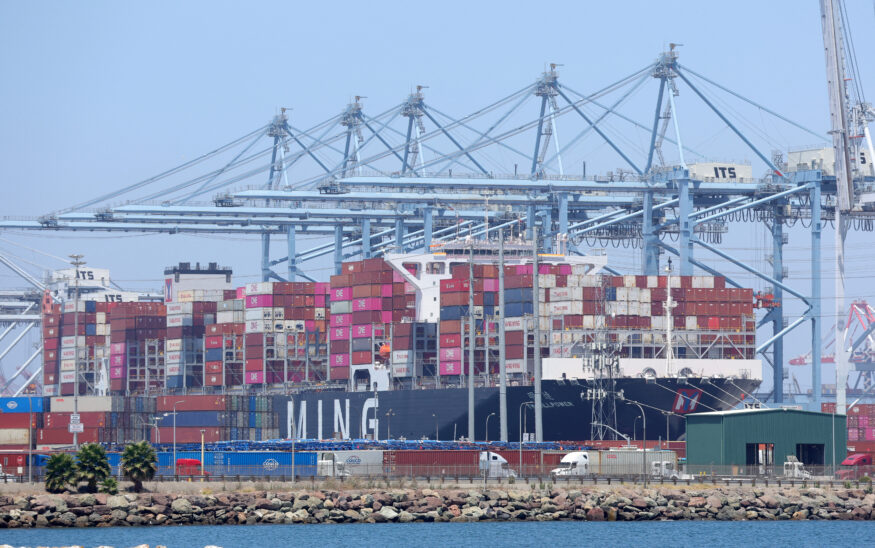
Shipping containers on a container ship at the Port of Long Beach, California, U.S. July 17, 2026. REUTERS/Mario Anzuoni
Shipping containers on a container ship at the Port of Long Beach, California, U.S. July 17, 2026. REUTERS/Mario Anzuoni
US goods trade deficit narrows but still weighs on Q2 GDP growth
Lucia Mutikani
Reuters //July 28, 2026//



In Brief:
- U.S. goods trade deficit shrinks 4.2% to $101.5 billion in June
- Exports fall to five-month low driven by industrial supplies drop
- Imports decline $8.2 billion amid fading restocking boost
- Trade expected to subtract around one percentage point from q2 GDP
WASHINGTON (Reuters) – The U.S. trade deficit in goods narrowed in June amid a broad decline in imports, but the improvement was probably insufficient to prevent trade from again subtracting from economic growth in the second quarter.
The Commerce Department report on Tuesday also showed exports dropping to a five-month low, pulled down by a sharp decline in shipments of industrial supplies, which include petroleum. The decrease likely reflected a pullback in crude oil prices amid a fragile ceasefire between the U.S. and Iran.
With businesses ramping up investment in artificial intelligence and consumer spending resilient, last month’s drop in imports could be temporary. The AI build-out is reliant on imports. The government on Monday reported a strong increase in orders and shipments for non-defense capital goods in June.
“Our model mapping the trade data onto the national accounts now points to net trade subtracting around one percentage point from second-quarter GDP growth,” said Oliver Allen, senior U.S. economist at Pantheon Macroeconomics.
The goods trade gap contracted 4.2% to $101.5 billion last month, the Commerce Department’s Census Bureau said. Economists polled by Reuters had forecast the goods deficit at $100.0 billion. The goods trade deficit, on average over the three months through June, remained wider than the first-quarter average.
Goods imports decreased by $8.2 billion to $306.2 billion. They increased by 16.6% year on year in June. The decline in monthly imports likely reflected the fading boost from businesses rushing to restock to avoid shortages and higher prices due to the Middle East conflict.
Consumer goods imports led the decline, down 3.8%. Imports of capital goods fell 2.0%, but surged 37.4% year-on-year. Food imports decreased by 2.5%, while those of automotive vehicles decreased by 2.5%. Industrial supplies imports fell 1.9%, likely reflecting lower oil prices.
Exports of goods fell $3.8 billion to $204.7 billion last month. Exports of industrial supplies tumbled 4.4%, also likely a function of lower crude prices. Food exports dropped 3.1%, while shipments of capital goods fell 1.1%.
But exports of automotive vehicles jumped 5.1%, and those of consumer goods increased 3.2%. The government is scheduled to publish its advance estimate of second-quarter gross domestic product growth on Thursday. A Reuters survey of economists estimates the economy grew at a 2.1% annualized rate last quarter, matching the first quarter’s pace.
Trade has subtracted from GDP for two straight quarters.
Stocks on Wall Street were higher. The dollar was lower versus a basket of currencies. U.S. Treasury yields fell.
Consumer Confidence Ebbs
Some of the anticipated drag from trade could be offset by robust business investment in equipment and an expected pickup in consumer spending. Inventories, which have been drawn down for four straight quarters, remain a wild card.
The Census Bureau report showed wholesale inventories increased 0.3% in June, matching May’s gain. Stocks at retailers were unchanged after rising 0.5% in May, though inventories at motor vehicle and parts dealers increased 0.4%.
Excluding motor vehicles and parts, retail inventories fell 0.2%. This component is included in the calculation of GDP. Other news on the economy on Tuesday was downbeat. A separate report from the Conference Board showed its consumer confidence index slipped to 90.8 this month from 92.2 in June, confounding economists’ expectations for a rise to 92.3.
Though the ebb in confidence largely reflected continued labor market pessimism, the Middle East conflict, entering its sixth month, continues to dampen household spirits. Confidence waned among respondents who identified as Independents and Democrats, while Republicans were somewhat more optimistic.
“Consumers’ write-in responses on factors affecting the economy continued to be mostly pessimistic in July,” said Dana Peterson, chief economist at the Conference Board. “Comments about food and grocery prices increased. Notably, references to jobs and unemployment picked up slightly.”
The share of consumers who view jobs as “plentiful” dropped to its lowest level since February 2021. There was a dip in the proportion saying jobs were “hard to get.”
Still, the survey’s so-called labor market differential, derived from respondents’ views on whether jobs are “plentiful” or “hard to get,” narrowed to 3.1 in July from 3.8 the previous month. This measure correlates to the unemployment rate in the Labor Department’s monthly employment report.
“Whatever hopes that the public had for change in Washington after the elections in November 2024 have now been replaced by the same old concerns about the future as a result of inflation’s higher prices and the ongoing affordability crisis,” said Christopher Rupkey, chief economist at FWDBONDS. “The latest reading does not herald a pullback or downturn in the economy, but economic growth is likely to remain moderate.”
The affordability crisis was underscored by a third report from the Federal Housing Finance Agency showing single-family house prices increased 2.2% year-on-year in May after rising 2.0% in April.
Rising house prices, combined with higher mortgage rates, are pushing homeownership out of reach for most young adults.
The average rate on the popular 30-year fixed-rate mortgage has increased by 60 basis points since the U.S. and Israel attacked Iran at the end of February. It averaged an 11-month high of 6.58% last week, according to data from mortgage finance agency Freddie Mac.
“Affordability and demand are still challenged,” said Michael Gapen, chief economist at Morgan Stanley. “Housing activity is bouncing along the bottoms. Given we do not expect much more support to affordability through the price channel, we likely need lower rates to spark demand.”
(Reporting by Lucia Mutikani; Editing by Chizu Nomiyama and Andrea Ricci)
e