Upcoming Event
 Free Newsletter

Colorado advanced industries face growth risks amid rising costs
ColoradoBiz Staff //August 5, 2026//
Courtesy of the Common Sense Institute.
Courtesy of the Common Sense Institute.
Colorado advanced industries face growth risks amid rising costs
ColoradoBiz Staff //August 5, 2026//



In Brief:
- Colorado advanced industries employed 364,806 workers in 2025
- Advanced industries paid average salary of $156,066
- Colorado ranked 38th for cost of doing business in 2026
- Colorado lost 11,700 nonfarm payroll jobs in 2025
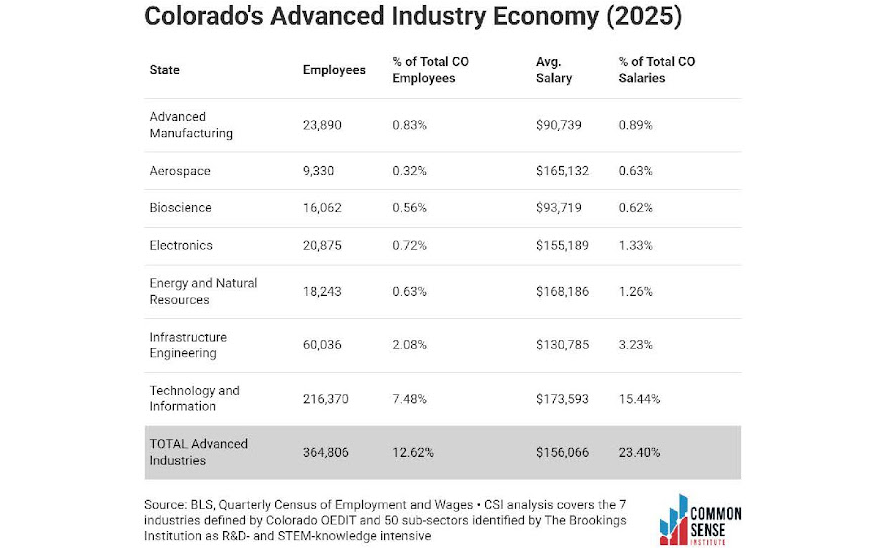
Colorado’s advanced industries employed 364,806 workers in 2025, but rising business and living costs could limit future growth, according to a Common Sense Institute report.
The seven sectors recognized as advanced industries by the Colorado Office of Economic Development and International Trade accounted for 12.6% of statewide employment, nearly 30% of sales revenue and almost 35% of exports.
Employment in the sectors increased 24% from 2019 to 2025, compared with overall state job growth of 5.7%. The industries paid nearly $57 billion in annual wages, with an average salary of $156,066. That was 85% higher than Colorado’s statewide average of $84,157.
Colorado ranked seventh among states for its concentration of advanced-industry jobs but 16th for total employment, the report said.
The state attracted $38.4 billion in venture capital and produced 3,167 venture-backed startups between 2019 and 2025. CU Boulder ranked first nationally for university startup spinoffs in 2024.
However, Colorado ranked 38th for the cost of doing business and 49th for cost of living in CNBC’s 2026 rankings. The state also fell from No. 22 in 2020 to No. 33 in the Tax Foundation‘s 2026 State Tax Competitiveness Index.
A tracker cited in the report identified 98 corporate departures or abandoned expansions since 2019. Those decisions represented more than 13,600 jobs among cases with available employment data. A separate analysis found Colorado had a net loss of 34 public company headquarters since 2022.
Colorado businesses conducted $11 billion in research and development, about 1.5% of the national total. California, Washington, Texas and Massachusetts accounted for a combined 54%.
The report also pointed to broader economic concerns. Colorado lost an estimated 11,700 nonfarm payroll jobs in 2025, its first annual decline since 2020. The state also recorded a net domestic population loss of about 12,100 people between July 2024 and July 2025, its first negative domestic migration since 2004.
-