Upcoming Event
 Free Newsletter

US trade deficit narrows in June amid falling imports and exports
Lucia Mutikani
Reuters //August 4, 2026//

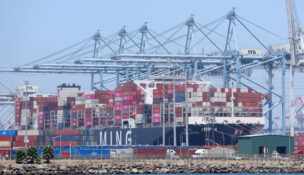
A cargo ship full of shipping containers is seen at the port of Oakland, California, U.S., August 4, 2025. REUTERS/Carlos Barria/File Photo
A cargo ship full of shipping containers is seen at the port of Oakland, California, U.S., August 4, 2025. REUTERS/Carlos Barria/File Photo
US trade deficit narrows in June amid falling imports and exports
Lucia Mutikani
Reuters //August 4, 2026//



In Brief:
- US trade deficit narrowed 5.6% to $73.3 billion in june
- Exports declined 0.9% to $314.7 billion led by industrial supplies
- Imports dropped 1.8% to $388.0 billion with lower capital goods
- Trade deficit with china widened to $15.3 billion in june
WASHINGTON (Reuters) – The U.S. trade deficit narrowed in June, but the trend is unlikely to be sustained amid an artificial intelligence buildout that is heavily reliant on imports.
Both imports and exports declined in June, the Commerce Department reported on Tuesday. The government last week estimated that the trade deficit subtracted a full percentage point from second-quarter gross domestic product growth.
“June’s report showed a welcome narrowing in the trade gap,” said Priscilla Thiagamoorthy, a senior economist at BMO Capital Markets. “We still see net exports subtracting from GDP growth in the couple of quarters ahead.”
The trade shortfall contracted 5.6% to $73.3 billion, the Commerce Department’s Bureau of Economic Analysis and Census Bureau said. Economists polled by Reuters had forecast the deficit at $73.0 billion.
Exports slipped 0.9% to $314.7 billion. Goods exports declined 1.9% to $206.9 billion. They were weighed down by a $3.3 billion decline in exports of industrial supplies and materials, which include petroleum. Crude oil exports fell by $5.7 billion, reflecting a decline in the average price. Crude oil export prices averaged $95.82 per barrel, down from $107.82 in May.
Exports of fuel oil fell by $1.6 billion, while those of nonmonetary gold increased by $3.4 billion. Capital goods slipped $0.6 billion amid a $1.1 billion drop in shipments of computers.
Imports dropped 1.8% to $388.0 billion in June. Goods imports fell 2.5% to $309.0 billion. The decline was led by a $2.1 billion drop in capital goods imports, which reflected a $3.0 billion decline in computers. Still, imports of computers are $95.4 billion higher so far this year than in the same period in 2025. There is a strong demand for technology goods as businesses invest heavily in AI. Imports of telecommunications equipment increased by $1.1 billion in June.
Robust Domestic Demand
Consumer goods imports fell by $2.1 billion, pulled down by a $1.9 billion drop in pharmaceutical preparations. Inflation-adjusted petroleum imports were the lowest since April 2020.
The so-called real goods trade deficit narrowed 5.3% to $94.5 billion in June. Exports of services increased $1.1 billion to $107.8 billion in June, lifted by financial and trade services. Imports of services increased $0.6 billion to $79.0 billion, amid a rise in charges for the use of intellectual property as well as gains in transport and insurance services. Imports of travel services, however, fell.
The economy grew at a 1.5% annualized rate last quarter, though domestic demand, driven by consumers and businesses ramping up spending on AI infrastructure, increased at its fastest pace since the first quarter of 2023.
The nation maintained goods trade deficits with many countries, including Canada, Germany, India, Malaysia, Japan, Ireland, Italy, France and Israel. It had record goods trade deficits with Mexico, Vietnam and South Korea in June. The goods trade deficit with China widened to $15.3 billion from $14.5 billion in May. The deficits have persisted despite President Donald Trump’s aggressive tariffs on imports.
“For the record, the trade deficit that President Trump vowed to extinguish was $79.8 billion in November 2024 when he was elected for another term, and it is still $73.3 billion in today’s figures for June 2026,” said Christopher Rupkey, chief economist at FWDBONDS.
(Reporting By Lucia Mutikani; Editing by Andrea Ricci)
g