Upcoming Event
 Free Newsletter

Courtesy of Colorado Outdoors.
Courtesy of Colorado Outdoors.
Insurance costs challenge Colorado housing projects
Eric Peterson //April 21, 2026//



This article appeared in the Spring 2026 issue of ColoradoBiz titled “Insurance roils housing projects.”
“Insurance has become a four-letter word,” laments Josh Marinos, COO and principal of Formativ, a Denver-based real estate developer. “Year over year, it’s probably gone up 10 to 12%, if not more.”
In Brief:
- Formativ reports 10-12% annual insurance cost increases
- Lockton cites Colorado insurance hikes near 10%
- David Dragoo notes 60% premium rise since 2017
- Colorado FAIR Plan expands commercial coverage in 2025
Formativ has focused on multifamily projects in Denver and Colorado Springs in recent years. “Insurance is up there as a deal breaker with financing costs and construction material costs,” he adds. “But it’s not like we can’t have it.”
Institutional investors “have certain requirements that we as a developer have to hit,” says Marinos. “As a developer, we have a choice to either provide our own insurance or go on the CCIP [contractor-controlled insurance program] with the general contractor. And there’s a cost for that.”
“To get to a $15 million dollar threshold, where before COVID we could get one policy to get that now, post-COVID, we usually have to get two to three excess policies of $5 million apiece from different carriers to hit that $15 million threshold.”
Adds Marinos: “We have to get extremely creative.”
Kyle Nagle is a risk consultant at the Denver office of Lockton, the Kansas City-based company that is the world’s largest privately owned insurance brokerage. “Colorado has a lot of challenges,” he says. “The cost of insurance is a challenge for a lot of real estate funds.”
Deals are stymied “all the time” due to insurance costs in Colorado and other states, notes Nagle. He says Florida is the poster child for skyrocketing insurance costs, but Colorado is on the next tier, with recent annual increases around 10 %.
Big real investment trusts (REITs) increasingly avoid Colorado projects due to the insurance wild card. “They’ll think that they can get it for $800 to $1,200 a door, and then once you really look at it and get all the right coverages, it ends up being $2,200 a door to insure that property,” says Nagle.
“The problem is, a lot of these projects are so big that capacity in the market is limited, too. Insurance companies can only offer a certain amount of coverage based on their capital reserves.”
Population growth is one culprit for recent hikes, leading to more exposure, alongside higher property values statewide. Hailstorms and wildfires are also big drivers of rate hikes.
“The damages from a hailstorm, people don’t realize it, but it’s significantly higher than the damages from a fire,” says Nagle. “A fire can cover a small area, but a hailstorm covers such a large region that it can be very devastating.”
“A lot of building owners have coverage for their roof for a hailstorm, but the deductibles are so high that it’s really self-insured. You’re talking 5 to 10% of the value of the building in some areas, that insurance companies are charging for a deductible. That number can be very difficult to take on if you’re a real estate investor.”
Colorado’s construction defects law has catalyzed higher rates that have chilled condominium projects. “Because of this construction defects law, it’s really impeding developers who want to develop high-density units,” says Nagle. “To get completed operations coverage for condos is very expensive in Colorado. You can make those projects happen if they pencil right, but you have to be in the right areas, such as Cherry Creek North, where you can get $1,000-plus a square foot.”
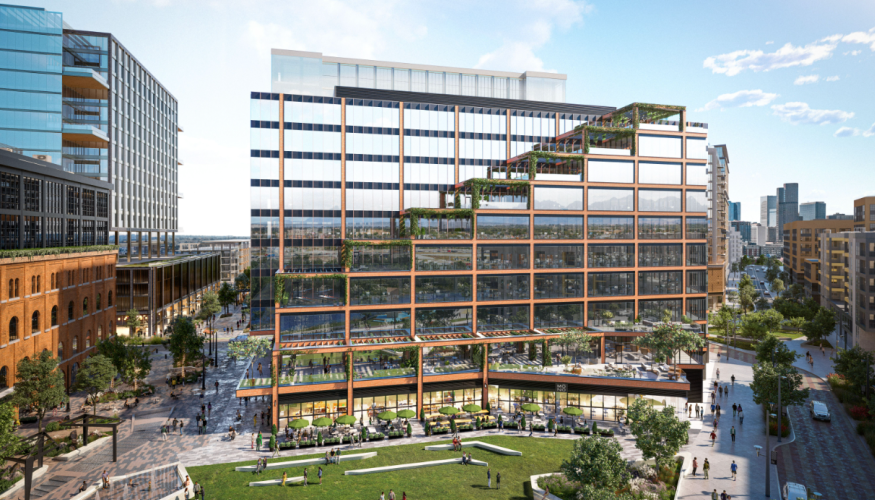
But affordable housing projects are another story. David Dragoo, who is behind the Colorado Outdoors mixed-use development in Montrose, wants to build workforce and affordable projects in the area, but skyrocketing insurance costs have been a stumbling block.
“Typically, on the Western Slope, capital stacks are thinner, so a 25 to 30% jump in premiums can be the difference between a project penciling or being shelved,” says Dragoo. “This is especially true for the workforce and affordable housing. You simply can’t raise the rents enough to cover the hit.”
Dragoo’s property insurance premiums have jumped by about 60% since 2017, and the last few years have been especially tough. “From a capital stack perspective, insurance line items used to grow a few percentage points per year,” he explains. “Now, we’re baking in 8 to 12% annual increases, and that can wipe out anywhere from 100 to 150 basis points of yield and then shrink your loan proceeds on already tight deals.”
“You’re already making a lot of concessions with the workforce and affordable to make it work, and insurance premiums are just a wild card,” he adds. “There are certain concessions you don’t want to make.”
A new hotel is also in the works at the Colorado Outdoors site. “A hotel is a commercial version of an apartment building, so the insurance on it is just wildly unpredictable. That’s the bottom line.”
Dragoo says he’s “always on pins and needles” while waiting for his broker’s quotes, but an insurance pool could ease his nerves. “There is strength in numbers. If there’s a way for workforce or affordable housing projects to tap into insurance as a co-op, that’s something the state could consider. But we just have no strength in numbers, because each project is underwritten on its own merit.”
Established in 2023, Colorado’s FAIR Plan, designed as a last resort for owners of high-risk properties who are unable to secure insurance through the traditional market, opened up to the commercial market in June 2025 after launching for homeowners earlier in the year. The coverage limit is $5 million and it only offers limited coverage for hail damage.
At Formativ, Marinos sees benefits in involving insurers during the pre-construction phase. He says his broker at IMA Select in Denver helped connect him with FM, a Rhode Island-based carrier, which did exactly that for The Hunter, a 214-unit apartment completed in Colorado Springs last year.
Robert Julavits, FM’s vice president of strategic communications, says the earlier insurance professionals get involved with a new development project, the better. “Working with an insurer in the design and construction phase can help ensure that resilience and loss prevention solutions are built into a project from the very beginning stages,” says Julavits. “It can also potentially reduce costs associated with improvements when they are considered in advance and help mitigate interruptions to project completion.”
“[FM] will actually come in and vet your drawings beforehand and show you what needs to be done in order to get a lower rate,” says Marinos. “This is a unique group. They’re a spinoff of an engineering firm, so they look at constructability and how you’re dealing with things a lot differently than some of the other insurers.”
Online:
- Formativ: www.formativco.com
- Lockton: global.lockton.com
- Colorado Outdoors: www.coloradooutdoors.co
- Colorado FAIR Plan: www.coloradofairplan.com
- IMA Select: www.imaselect.com
- FM: www.fm.com
r