Upcoming Event
 Free Newsletter

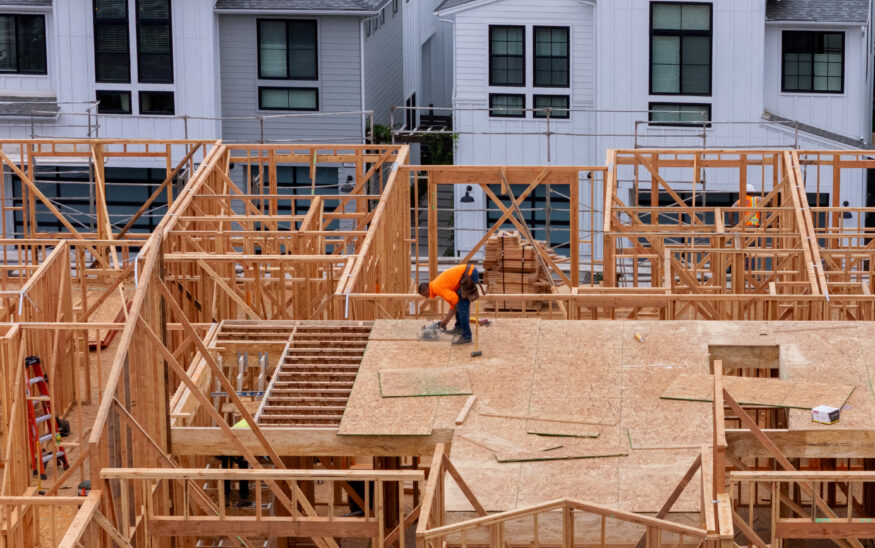
A drone view shows a construction worker performing tasks on a multi-home residential project by Shea Homes in Encinitas, California, U.S. July 21, 2025. REUTERS/Mike Blake/File Photo
A drone view shows a construction worker performing tasks on a multi-home residential project by Shea Homes in Encinitas, California, U.S. July 21, 2025. REUTERS/Mike Blake/File Photo
US construction spending falls 0.3% in January
Lucia Mutikani
Reuters //March 23, 2026//



WASHINGTON (Reuters) – U.S. construction spending unexpectedly fell in January amid broad weakness in private projects, government data showed.
In Brief:
- U.S. construction spending fell 0.3% in January, missing forecasts
- Private construction dropped 0.6%, with residential spending down 0.8%
- Mortgage rates rose to 6.22%, weighing on housing activity
- Public construction increased 0.6%, led by state and federal projects
The Commerce Department’s Census Bureau said on Monday that construction spending dropped 0.3% after an upwardly revised 0.8% jump in December, which was the largest increase since April 2024.
Economists polled by Reuters had forecast construction spending would edge up 0.1%. Construction spending rose 1.0% on a year-over-year basis in January.
The Census Bureau is still catching up on data releases following delays caused by last year’s government shutdown.
Spending on private construction projects fell 0.6% in January after increasing 1.0% in December. Investment in residential construction decreased 0.8% after soaring 2.5% in December, which partly reflected the impact of a rise in renovations. Spending on new single-family housing projects fell 0.2% as higher mortgage rates continue to constrain activity.
Though mortgage rates eased at the start of the year, they have been rising since the U.S.-Israeli war with Iran started at the end of February. The Middle East conflict has boosted oil prices and U.S. Treasury yields amid mounting inflation fears.
The average rate on the popular 30-year fixed-rate mortgage has jumped to 6.22% from 5.98% on the eve of the war, according to Freddie Mac data. Mortgage rates track the benchmark 10-year Treasury yield. Rising mortgage rates are adding to higher material and labor costs, driven by import tariffs and an immigration crackdown.
Residential investment has declined for four straight quarters. Spending on multi-family housing units, which account for a small share of the housing market, fell 0.7% in January.
Spending on private nonresidential structures, such as offices and factories, fell 0.4% in January. Spending on nonresidential structures has contracted for eight consecutive quarters, despite a surge in data center construction to support artificial intelligence.
Investment in public construction projects increased 0.6% after dipping 0.1% in December. State and local government construction spending rose 0.6% in January, and outlays on federal government projects increased 1.0%.
(Reporting by Lucia Mutikani; Editing by Paul Simao)
i