Upcoming Event
 Free Newsletter

Why your Colorado business may not be a reliable retirement plan
Nelisha Firestone, founder
Firestone Financial Group //July 24, 2026//
Courtesy of Firestone Financial.
Courtesy of Firestone Financial.
Why your Colorado business may not be a reliable retirement plan
Nelisha Firestone, founder
Firestone Financial Group //July 24, 2026//



In Brief:
- Exit Planning Institute: 70-80% wealth tied in business equity
- Owner dependency lowers business valuation significantly
- Customer concentration over 15-20% poses risk to buyers
- Certified Exit Planning Advisor key to successful exit
For the typical entrepreneur, the business is more than a source of income. It is an identity, a passion project, and a legacy. So, it’s not surprising that small business equity is usually an owner’s single largest asset. In fact, ask any business owner about their retirement strategy, and you will likely receive a quick, confident response: “My business is my retirement.”
It sounds logical. You poured your life savings, weekends, and sweat equity into building a profitable enterprise. Naturally, you assume that when the time comes to step away, the business will seamlessly transform into a liquid nest egg to fund your golden years.
But for most business owners, this assumption is not a sound strategy, but a risky financial gamble. Why? The answer is simple but often overlooked: building a profitable business is completely different from building a sellable asset.
According to the Exit Planning Institute, 70% to 80% of most business owners’ wealth is tied up in business equity. Given that, it’s important to note that most small-to mid-sized businesses put up for sale never actually close. Relying on your business for retirement without an active, strategic exit plan is a roll of the dice that leaves your financial future uncertain.
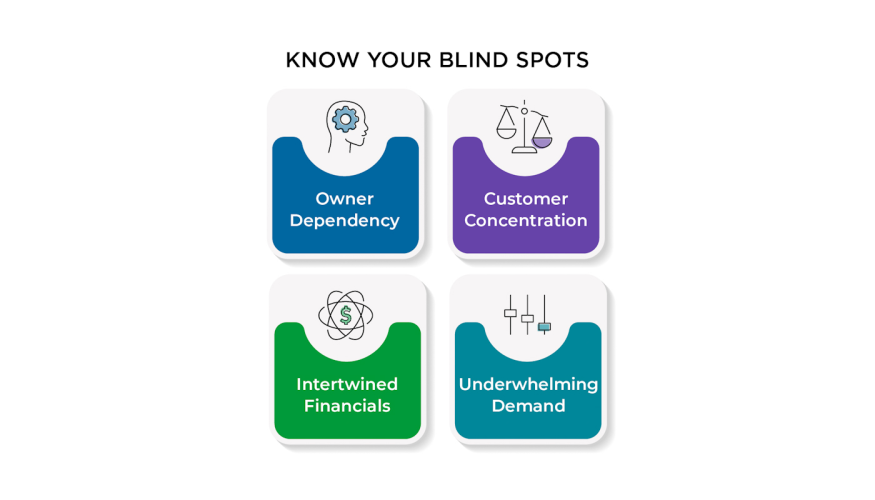
Know Your Blind Spots
To understand why so many business owners get tripped up by exit strategy – or lack thereof – let’s take a look at the most common pitfalls that make an otherwise healthy company unmarketable:
Owner Dependency
The most common point of failure is owner dependency. If your business cannot successfully operate for a full month without your direct intervention, you do not own a company – you own a high-paying job.
Private equity firms, competitors, and independent buyers are not looking to purchase a 60-hour workweek. They want to buy a self-sustaining business that generates predictable cash flow. If the institutional knowledge, customer relationships, and decision-making live only in your head, the business carries a much lower valuation than you might expect.
Customer Concentration
Another common red flag is a customer whale. If a single client accounts for more than 15% to 20% of your total revenue, your business carries greater risk. Buyers understand that if a single client leaves after the acquisition, the investment could collapse.
Business or Pleasure?
It’s nearly impossible for most business owners to fully separate their personal and business finances. Blending personal benefits, family vehicles, and subjective expenses into the company ledger can lead to messy financials. Even if records are entirely legitimate, a buyer’s accountant or attorney may see liability. If you cannot show clean, impenetrable, and auditable books, buyers could walk away.
The Myth of the Eager Competitor
Finally, put your ego in check and never assume your competitors are waiting in the wings to scoop your business up just to increase market share. Competitors rarely want to buy your overhead, your real estate, or your old equipment. Unless you possess proprietary technology, exclusive contracts, or a highly specialized workforce, it is often cheaper for a competitor to simply wait for you to burn out, retire, and absorb your client base for free.
Ignore Exit Planning at Your Peril
Think about it – most people spend more time, money, and preparation selling a house than selling a business. Just as careful planning improves your ability to secure top dollar for your home, a clear, focused exit strategy can help maximize the value of your business.
You can’t avoid an eventual exit from your business. But failing to plan can mean the difference between a highly successful and profitable exit and a chaotic, expensive one. Consider the unknown. When retirement is forced by health issues, economic downturns, or operational burnout, the lack of preparation carries heavy financial penalties.
When an owner is forced to execute a distressed liquidation, inventory and equipment are sold for a fraction of their value, and the brand’s goodwill evaporates.
Even if you manage to find a buyer under duress, the tax consequences can be significant. Without proactive tax structuring completed years in advance, the IRS can easily claim up to 40% of your transaction proceeds through capital gains, depreciation recapture, and state taxes.
Most importantly, time is leverage. When you are forced to sell quickly due to exhaustion or illness, you lose the ability to walk away from bad terms. You become a motivated seller dealing with buyers who will aggressively chip away at your valuation.
How to Create a Viable Exit Strategy
Transitioning your business into a true retirement vehicle requires shifting your mindset from operational growth to asset optimization. This requires building an intentional exit strategy at least five years before you intend to exit the building.
Secure a Valuation Reality Check
The exit planning process begins with an objective, third-party business valuation. Do not rely on industry rules of thumb or back-of-the-napkin math. You must know exactly what your business is worth in the current market. This numbers-driven baseline helps you to calculate your “wealth gap” – the financial distance between your current net worth and the liquid capital required to fund your target retirement lifestyle.
De-Risk Your Asset
Once you identify the wealth gap, focus your operational energy on de-risking the company to boost value. Standardize and document every core business process. Elevate the middle management tier and delegate key operational decisions. Diversify your revenue streams so no single industry or client dictates your financial survival. A buyer will pay a premium for an organization that functions like a well-oiled machine without its founder.
Evaluate Your Exit Vehicles
An exit strategy is not a one-size-fits-all roadmap. Think about which transition vehicle aligns with your financial and personal goals:
- Third-Party Sale: Selling to a strategic buyer or private equity firm typically yields the highest purchase price but demands the most intense due diligence.
- Management Buyout: Transitioning ownership to key employees can protect your legacy, though it often requires you to seller-finance the deal over several years.
- Employee Stock Ownership Plan: This vehicle offers significant tax advantages and preserves corporate culture, but requires substantial scale and administrative costs.
- Intergenerational Transfer: Passing the business to family members requires careful estate planning to ensure the transfer does not trigger catastrophic tax events or family friction.
Build Your Team
Successfully managing exit planning alongside your daily operations can be challenging, but you don’t have to go it alone. Even if you are satisfied with your financial advisor or accountant, most are not fully equipped to take the lead on exit planning.
A solid team of advisors should include a Certified Exit Planning Advisor (CEPA) to coordinate the strategy, a specialized accountant to optimize your tax footprint, a wealth manager to structure your post-sale income, and an attorney to protect your legal liabilities during contract negotiations. Kickstart the process by looking for a trusted CEPA who can help build a strategy and assemble your team.
Moving from Operator to Shareholder
A well-run business is a sellable business. The steps required to prepare your company for a premium market exit – cleaning up financial records, empowering leadership, documenting processes, and mitigating client risks – are the same factors that make a business highly profitable to begin with.
Consider this: Do you think of exit planning as an administrative chore or a core business strategy? By focusing on exit planning and shifting your perspective from a day-to-day operator to an intentional shareholder, you can protect your company’s legacy and ensure the asset you’ve spent years building can fund the retirement you have earned.
Nelisha Firestone is the founder of Firestone Financial Group, who helps business owners build and preserve wealth through their greatest sweat equity – their business asset. A Certified Exit Planning Advisor (CEPA), she focuses first on her clients’ most significant assets – often illiquid holdings such as privately held businesses, investment real estate, or highly appreciated company stock. Her practical, relationship-driven approach has made her a trusted advisor for women navigating major life transitions and pivotal financial decisions.
-