Upcoming Event
 Free Newsletter

Report: Colorado business confidence improves but remains negative
ColoradoBiz Staff //January 7, 2026//
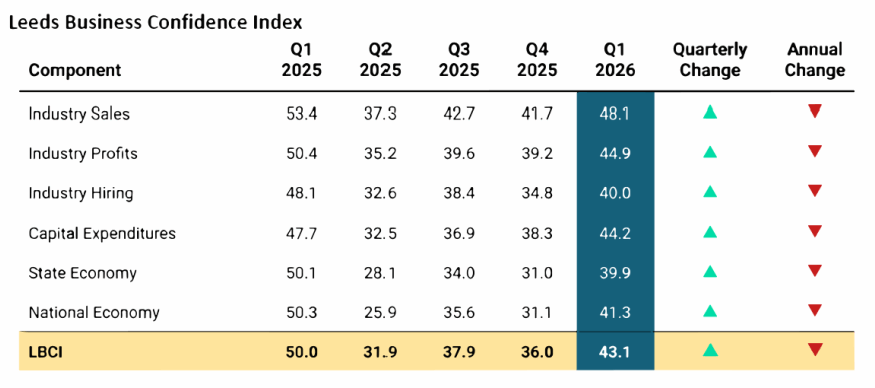
January 2026 Leeds Business Confidence Index. Courtesy of the University of Colorado Leeds Business School.
January 2026 Leeds Business Confidence Index. Courtesy of the University of Colorado Leeds Business School.
Report: Colorado business confidence improves but remains negative
ColoradoBiz Staff //January 7, 2026//



DENVER — Business confidence among Colorado companies improved heading into 2026, though sentiment remained negative and below levels reported a year earlier, according to the latest Leeds Business Confidence Index.
In Brief:
- Leeds Business Confidence Index rose to 43.1 ahead of Q1 2026
- Politics, tariffs and uncertainty weigh on business outlook
- Sales and profit expectations posted the strongest gains
- Most respondents see emerging risks weighted to the downside
Ahead of the first quarter of 2026, the index rose to 43.1 from 36 in the fourth quarter of 2025. A score of 50 is considered neutral, leaving the index in negative territory. The largest gains were recorded in national and state economic outlooks, while sales and profits posted the highest index levels overall.
The Leeds Business Confidence Index is prepared by the Business Research Division at the University of Colorado Boulder’s Leeds School of Business. The survey measures expectations for the national and state economies, industry sales, profits, hiring plans and capital expenditures.
All six components of the index increased from the fourth quarter of 2025 to the first quarter of 2026, though perceptions remained negative. Politics, tariffs and uncertainty were cited most often by respondents, followed by concerns about the labor market, the national economy, inflation and interest rates.
Respondents also identified tariffs, interest rates, the federal budget and artificial intelligence as the most significant emerging risks expected to affect their industries in the next six months.
About 70% of respondents said emerging risks were weighted to the downside, while fewer than one-third viewed them as upside risks, said Brian Lewandowski, executive director of the Business Research Division. While the perception of risk aligns with overall index sentiment, he said it also shows some business leaders see upside potential in the coming months.
Sales and profit expectations rose ahead of the first quarter, with the index levels for both reaching their highest and second-highest levels, respectively. The sales index increased to 48.1 in the first quarter from 41.7 in the fourth quarter of 2025 and rose to 52.1 in the second quarter. The profits index increased to 44.9 from 39.2 and rose to 49 in the second quarter of 2026.
Expectations for both the state and national economies also improved. State expectations increased to 39.9 in the first quarter, up from 31 in the fourth quarter of 2025, and rose to 42 for the second quarter of 2026. National expectations posted the largest gain, rising to 41.3 from 31.1 and increasing to 44.2 in the second quarter.
“While still below neutral, the uptick in the overall index is quite positive,” said Rich Wobbekind, faculty director of the Business Research Division. “My greatest area of concern is that the state expectations component remains below the national, a relatively recent phenomenon not seen since 2005.”
For the state economy, 52.9% of respondents reported a negative outlook, while 18.2% expected a moderate to strong increase and 28.9% were neutral. At the national level, 52.6% were negative, 24.4% expected an increase and 23.1% were neutral.
Inflation in the Denver-Aurora-Lakewood area rose 2.2% year over year in November 2025, below the national average of 2.7%. Employment in Colorado increased 0.6% year over year in September, ranking the state 30th nationally for job growth.
i