Upcoming Event
 Free Newsletter

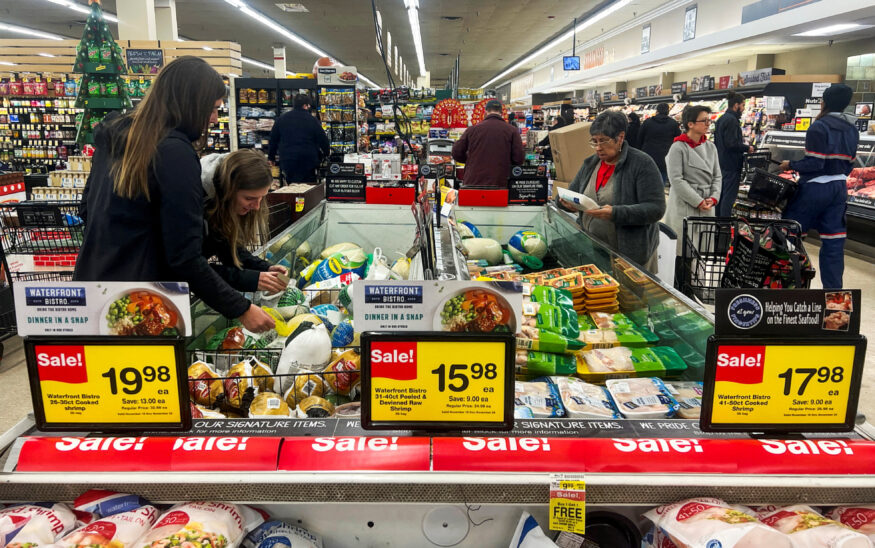
Shoppers crowd a supermarket to buy food ahead of the Thanksgiving holiday in Chicago, Illinois, U.S. November 22, 2022. REUTERS/Jim Vondruska/File Photo
Shoppers crowd a supermarket to buy food ahead of the Thanksgiving holiday in Chicago, Illinois, U.S. November 22, 2022. REUTERS/Jim Vondruska/File Photo
US consumer confidence hits 11-year low in January
Lucia Mutikani
Reuters //January 27, 2026//



WASHINGTON (Reuters) – U.S. consumer confidence slumped to the lowest level in more than 11-1/2 years in January amid mounting anxiety over a sluggish labor market and high prices, which could see households becoming more cautious about spending.
In Brief:
- U.S. consumer confidence fell to its lowest level since 2014
- The Conference Board index dropped 9.7 points in January
- Consumers cited job market concerns and high prices
- Economists warned the decline could slow consumer spending
The surprise deterioration in confidence reported by the Conference Board on Tuesday was across political party affiliation, with survey respondents identifying as Independents the most pessimistic. It could add to pressure on President Donald Trump to address what economists and opponents have called an affordability crisis, which they have blamed on his policies, including sweeping tariffs on imports.
While the relationship between confidence and consumer spending has been weak, some economists were concerned that the slump would be accompanied by poor perceptions of the labor market. Consumers’ views of job availability were the weakest in nearly five years.
Nonetheless, economists did not expect the decline in confidence to influence the outcome of the Federal Reserve‘s policy meeting. The U.S. central bank is expected to leave interest rates unchanged on Wednesday. Consumers’ expectations were the lowest in nine months, which some economists said flagged a slowdown in spending.
“Admittedly, the expectations index has greatly overstated the weakness in spending in recent quarters,” said Oliver Allen, senior U.S. economist at Pantheon Macroeconomics. “But we’d be surprised if its recent deterioration proves to be an entirely false signal, particularly given the recent stagnation in real incomes and the already rock-bottom personal saving rate.”
The Conference Board’s consumer confidence index plunged 9.7 points to 84.5 this month, the lowest level since May 2014. Economists polled by Reuters had forecast the index at 90.9. The cutoff date for the survey was January 16, well after the capture of Venezuelan President Nicolas Maduro by U.S. forces.
The drop contrasted with the improvement in the University of Michigan’s sentiment measure last week.
The decline in confidence was sharpest among consumers aged 35 and older, as well as households with annual incomes below $15,000 and those with incomes of $50,000 or more. Confidence also fell among higher-income households. Higher-income households have largely been driving strong spending, which economists have called K-shaped, helping to underpin the economy even as job growth has almost stalled.
“References to prices and inflation, oil and gas prices, and food and grocery prices remained elevated,” said Dana Peterson, chief economist at the Conference Board. “Mentions of tariffs and trade, politics and the labor market also rose, and references to health insurance and war edged higher.”
Investors largely shrugged off the deterioration in confidence. Stocks on Wall Street were trading higher. The dollar fell against a basket of currencies. U.S. Treasury yields were mixed.
Consumers’ Labor Market Perceptions Deteriorated
The share of consumers who viewed jobs as being “plentiful” dropped to 23.9%, the lowest since February 2021, from 27.5% last month. Some 20.8% of consumers said jobs were “hard to get,” the highest since February 2021, up from 19.1% in December. The survey’s so-called labor-market differential, derived from respondents’ views on whether jobs are plentiful or hard to get, dropped to 3.1. That was also the lowest since February 2021, down from 8.4 last month.
This measure correlates to the unemployment rate in the Labor Department’s monthly employment report. It raised the risk that the jobless rate would creep up this month from 4.4% in December. Economists say the Trump administration’s aggressive trade and immigration policies have reduced both demand for and supply of workers.
Businesses are also unsure of their staffing needs as they invest heavily in artificial intelligence, limiting hiring.
“An increasing share of consumers think there are fewer jobs available today,” said Tim Quinlan, a senior economist at Wells Fargo. “That point alone isn’t enough to cause households at large to stop spending, but it does result in some more cautious spending behavior, specifically those with less discretionary income like lower-income households.”
Fewer consumers planned to purchase big-ticket items over the next six months. Vacation was also not in the cards for many, while plans to buy a home dropped to a nine-month low.
Last week, Trump signed an executive order restricting institutional investors from buying single-family homes as part of an effort to make housing more affordable. The Trump administration is also purchasing mortgage-backed securities, which initially led to a decline in mortgage rates.
Economists and realtors, however, expect these measures would have a limited impact on housing affordability. They said more housing inventory, especially at the lower end of the market, was needed to address the problem.
Homebuilding is constrained by high material costs due to tariffs, including on lumber, as well as by high borrowing costs. There is also a labor shortage that has been worsened by the immigration crackdown. Building lots are also scarce amid state and local government regulations.
Tight inventory is keeping house prices high. A separate report from the Federal Housing Finance Agency showed that single-family house prices increased 0.6% month over month in November, after rising 0.4% in October. Prices climbed 1.9% in the 12 months through November, after advancing 1.8% in October.
“Mortgage rates are now about 85 basis points lower than a year ago, while unsold inventory has been falling,” said Alexandra Brown, North America economist at Capital Economics. “This should all put upward pressure on house price growth. We are forecasting house prices to rise by 3.5% this year.”
(Reporting by Lucia Mutikani; Editing by Chizu Nomiyama and Andrea Ricci)
i