
Upcoming Event
 Free Newsletter

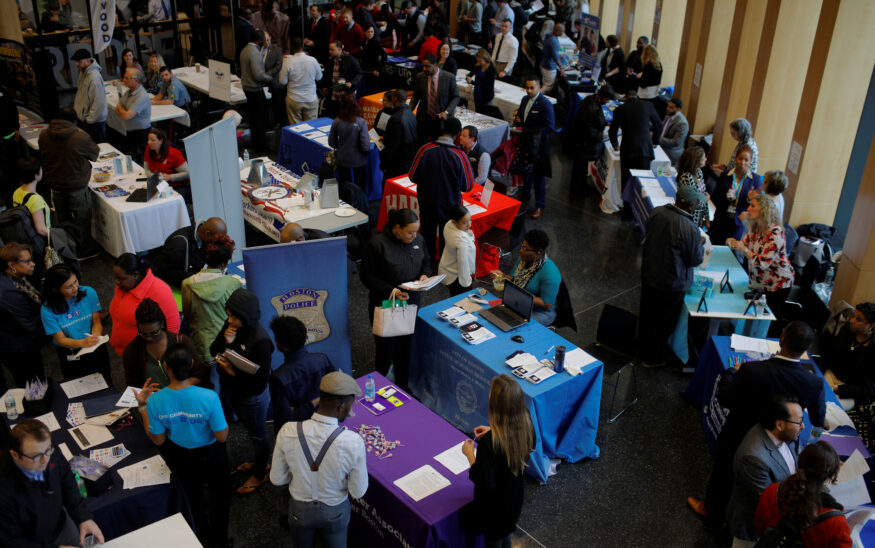
Job seekers speak with potential employers at a City of Boston Neighborhood Career Fair on May Day in Boston, Massachusetts, U.S., May 1, 2017. REUTERS/Brian Snyder
Job seekers speak with potential employers at a City of Boston Neighborhood Career Fair on May Day in Boston, Massachusetts, U.S., May 1, 2017. REUTERS/Brian Snyder
US consumer spending rises as labor market stays weak
Lucia Mutikani
Reuters //January 22, 2026//



WASHINGTON (Reuters) – U.S. consumer spending increased solidly in November and October as households stepped up purchases of a range of goods and services, likely keeping the economy on track for a third straight quarter of strong growth.
In Brief:
- US consumer spending increased 0.5% in November
- Households boosted spending on services and goods
- The saving rate fell to a three-year low of 3.5%
- Labor market remains in a low-hiring, low-firing pattern
But the boom in economic growth evident in Thursday’s reports has not been accompanied by a strong labor market. Economists say President Donald Trump’s aggressive trade and immigration policies have reduced the demand for and supply of workers. Businesses are uncertain about their staffing needs as they invest heavily in artificial intelligence, which is curbing hiring.
With the labor market stuck in what economists and policymakers have termed a “low-hiring, low-firing” state, the economic expansion is being powered by high-income households, who are spending more on travel and other experiential activities, and by businesses splurging on AI.
Economists said strong consumer spending and a stable labor market have reduced the need for the Federal Reserve to cut interest rates next week. While inflation was moderate in November and October, those readings likely reflected distortions caused by the 43-day government shutdown, and there are signs that price pressures have since picked up.
“Consumer spending remained remarkably resilient … yet this impressive strength masks a more troubling reality,” said Lydia Boussour, senior economist at EY-Parthenon. “Beneath the surface, many families are grappling with depleted savings and the challenges of fewer job opportunities and slower income growth, which is eroding their purchasing power.”
Consumer spending, which accounts for more than two-thirds of economic activity, rose 0.5% in November after rising by the same margin in October, the Commerce Department‘s Bureau of Economic Analysis said. The increase in November was in line with economists’ expectations. The combined October and November data were delayed by the government shutdown.
Spending in November was supported by the healthcare, financial services and insurance sectors as well as housing and utilities. Consumers also spent more on hotel and motel stays and restaurant and bar purchases. Services spending increased 0.4% after advancing 0.6% in October.
Spending on goods jumped 0.7% after rising 0.3% in October. There was increased spending on motor vehicles, clothing and footwear, as well as furniture and other durable household equipment, recreational goods and vehicles.
Spending on gasoline and other energy goods surged, reflecting higher prices. When adjusted for inflation, consumer spending increased 0.3%, matching the October gain and keeping the economy on a higher growth path in the fourth quarter.
The BEA earlier on Thursday reported that the economy grew at an upwardly revised 4.4% annualized rate in the third quarter, the fastest pace in two years. The economy was previously estimated to have grown at a 4.3% rate in the July-September quarter after expanding at a 3.8% pace in the second quarter. The Atlanta Fed is forecasting GDP will increase at a 5.4% rate in the October-December quarter, with contributions also expected from a smaller trade deficit and business investment.
Stocks on Wall Street were trading higher. The dollar fell versus a basket of currencies. U.S. Treasury yields were mixed.
Saving Rate At A Three-Year Low
Consumers, however, are dipping into their savings to maintain spending. The saving rate fell to a three-year low of 3.5% in November from 3.7% in October. Income increased 0.3% after edging up 0.1% in October as government wages and salaries fell $13.0 billion, reflecting the departure in September of public employees who accepted a deferred resignation offer.
Wages increased 0.4% in November after gaining 0.3% in October. The labor market remains in a holding pattern. A separate report from the Labor Department showed initial claims for state unemployment benefits increased 1,000 to a seasonally adjusted 200,000 for the week ended January 17.
Claims data have, in recent weeks, been clouded by challenges in adjusting for seasonal fluctuations around the year-end holiday season and the turn of the year. The claims data covered the period during which the government surveyed employers for the nonfarm payrolls component of January’s employment report.
The four-week moving average of claims, which irons out seasonal fluctuations from the data, increased modestly between the January and December survey weeks. Nonfarm payrolls increased by 50,000 jobs in December, roughly in line with the monthly average for 2025.
The number of people receiving unemployment benefits after an initial week of aid, a proxy for hiring, fell 26,000 to a seasonally adjusted 1.849 million during the week ended January 10, the claims report showed.
Part of the decline in the so-called continuing claims is also likely due to seasonal adjustment difficulties, as well as some people exhausting their eligibility for benefits, limited to 26 weeks in most states. Those who are laid off are finding it difficult to land new jobs, a trend evident in consumer surveys.
Though inflation subsided in October and November, it was because the shutdown injected a downside bias to prices. The government was unable to collect most of the data to compile the Consumer Price Index report for October. Similarly, most data was unavailable for October’s import prices report.
These data gaps also impacted CPI and import price reports for November. But the government was able to publish the October Producer Price Index report. The Personal Consumption Expenditures price indexes, tracked by the U.S. central bank for its 2% target, are calculated using data from the CPI, PPI, and import price reports.
The BEA used an average of September and November to calculate the relevant components for the PCE price indexes.
The PCE price index increased 0.2%, matching October’s gain. Goods prices rebounded after dipping in October, while services inflation slowed. In the 12 months through November, the PCE price index climbed 2.8%, up from 2.7% in October.
Excluding the volatile food and energy components, the PCE price index rose 0.2% after increasing by the same margin in October. In the 12 months through November, the so-called core inflation increased 2.8% after advancing by 2.7% in October.
CPI data for December have suggested core PCE picked up last month, with economists’ estimates as high as a 0.4% increase, which would translate to a year-on-year rise of 3.1%. The PCE inflation data for December will be released on February 20.
“The Fed will postpone cuts until it sees evidence of easing inflationary pressures,” said Michael Gapen, chief economist at Morgan Stanley.
(Reporting by Lucia Mutikani; Editing by Chizu Nomiyama and Paul Simao)
e