Upcoming Event
 Free Newsletter

US job losses in July temper Federal Reserve rate hike expectations
Lucia Mutikani
Reuters //August 7, 2026//
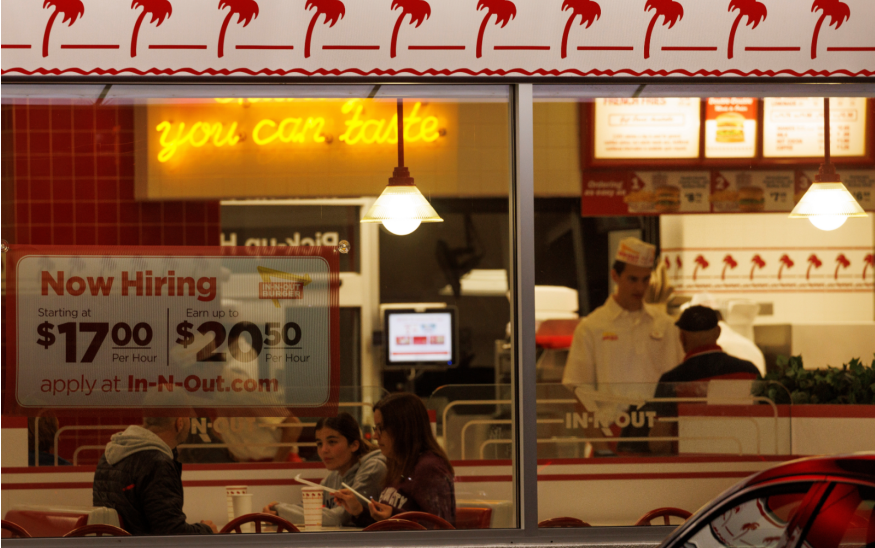
A "Now hiring" sign is displayed on the window of a fast food restaurant in Encinitas, California, U.S., May 9, 2022. REUTERS/Mike Blake/File Photo
A "Now hiring" sign is displayed on the window of a fast food restaurant in Encinitas, California, U.S., May 9, 2022. REUTERS/Mike Blake/File Photo
US job losses in July temper Federal Reserve rate hike expectations
Lucia Mutikani
Reuters //August 7, 2026//



In Brief:
- US economy lost 23,000 jobs in July
- Local government education jobs dropped 49,600
- Federal Reserve rate hike odds fall to 44% for September
- Financial activities employment down 14,000 jobs
WASHINGTON (Reuters) – The U.S. economy unexpectedly shed jobs in July, and previously reported job gains for the prior two months were revised sharply lower, tempering financial market expectations for an interest rate hike from the Federal Reserve next month.
While the Labor Department‘s closely watched employment report on Friday showed the unemployment rate falling to 4.1% last month from 4.2% in June, that was because another 264,000 people left the labor force, pushing the participation rate to a near 5-1/2-year low of 61.4%, and hampering hiring.
Job growth, however, tends to slow down during summer, a phenomenon that economists attribute to difficulties in adjusting for seasonal fluctuations related to the timing of the end of the school year. Much of the decline in payrolls, the first in five months, was centered in local government education. There was a second straight month of job losses in the leisure and hospitality industry, attributed by economists to the fading boost from the FIFA World Cup.
Economists urged caution in interpreting the data as a sign of an abrupt deterioration in the labor market, with some still viewing the labor market as in a “slow hire, slow fire” mode.
“This is the third summer in a row that we have seen unexpected weakness in the labor market,” said Stephen Stanley, chief U.S. economist at Santander U.S. Capital Markets. “Policymakers broadly see the labor market as stable.”
Nonfarm payrolls decreased by 23,000 jobs last month, the Labor Department’s Bureau of Labor Statistics said. Economists polled by Reuters had forecast payrolls rising 80,000 after advancing by a previously reported 57,000 in June. Estimates ranged from 10,000 to 140,000 jobs added.
The economy added 103,000 fewer jobs in May and June than previously estimated. Last year’s big downgrades to the two months led to President Donald Trump’s firing of the BLS commissioner, Erika McEntarfer. Trump, without offering evidence, accused McEntarfer of manipulating the data. On Friday, the Senate approved career economist Brett Matsumoto to take over as BLS commissioner.
Job growth averaged 20,000 per month over the past three months. It averaged 77,000 per month in the three months through June. Financial markets priced in a 44% chance of the U.S. central bank hiking rates in September, compared with 57% before the jobs report, according to LSEG data. The Fed last week left its benchmark overnight interest rate in the 3.50%-3.75% range.
Three members of the Fed’s policy-setting committee dissented, preferring a quarter-percentage-point hike. Next week’s inflation data could sharpen the debate on the near-term monetary policy outlook. Stocks on Wall Street were trading higher. U.S. Treasury yields fell, while the dollar slipped against a basket of currencies.
Local Government Education Drag
Local government education employment dropped 49,600 last month, the most since October 2021, and contributed to a 53,000 decrease in overall government payrolls. Excluding government, private payrolls increased by 30,000, matching June’s gain.
Private job growth has averaged 72,000 per month this year, and some economists argue that this better reflects the labor market. They expected the slump in local government to reverse in August.
Leisure and hospitality employment decreased by 40,000, marking a second straight month of job losses. Payrolls at restaurants and bars dropped by 26,100. The retail trade sector lost 19,400 jobs, the bulk of them at warehouse clubs, supercenters and other general merchandise stores.
These two sectors, which have become volatile in recent months, weighed down overall payrolls by 59,400 jobs.
Employment in financial activities fell further, shedding 14,000 jobs. Financial activities jobs are down by 121,000 since peaking in May 2025. Healthcare payrolls increased by 22,000, but were well below the monthly average of 36,000 over the past year.
There were 22,000 construction jobs added, while manufacturing employment rose by 5,000. A total of 31,000 factory jobs have been added this year, likely driven by an artificial intelligence buildout. But the share of manufacturing industries reporting employment gains dropped to 50.0% from 56.9% in June.
The overall share of industries reporting job growth fell to 51.8% from 53.2% in June. The Trump administration’s aggressive crackdown on illegal immigration has sharply reduced the labor supply. The labor force has decreased by more than a million this year. Further decreases are likely as hundreds of thousands of immigrants have lost their protected status.
“Since January, the labor force has fallen by 228,000 persons per month and these individuals appear to have been foreign- born,” said John Ryding, economic advisor at Brean Capital. “It is hard not to attribute the decline in the labor force to immigration enforcement and policies. From the Fed’s perspective, the labor market is at full employment and the economy cannot create jobs from people who are not here.”
The average workweek was 34.3 hours, which could argue against the claim that labor shortages are hurting hiring. Wage growth slowed, increasing 3.2% year-on-year after rising 3.4% in June. That, together with the weak payrolls, convinced some economists that the Fed would not tighten monetary policy this year.
Economists estimated the economy needs to create between 20,000 and 50,000 jobs per month to keep up with growth in the working-age population. The low so-called break-even rate reflected the shrinking labor pool.
Household employment dropped 87,000, and the number of people working part-time for economic reasons increased 123,000 to 4.804 million. The median duration of unemployment fell to a still-elevated 10.5 weeks from 11.0 weeks in June.
The labor force participation rate, or the proportion of working-age Americans who have a job or are looking for one, has declined in six of the past seven months and is now the lowest since February 2021. The employment-to-population ratio, viewed as a measure of an economy’s ability to create employment, extended its decline and is now near a five-year low.
“We agree that the July jobs report was a bit dovish on net,” said Aditya Bhave, a U.S. economist at Bank of America Securities. “But we are sticking with our call that the Fed will hike by 75 basis points this year, starting in September. The Fed is likely to remain more focused on inflation than labor.”
(Reporting by Lucia Mutikani; Editing by Dan Burns and Andrea Ricci)
l