Upcoming Event
 Free Newsletter

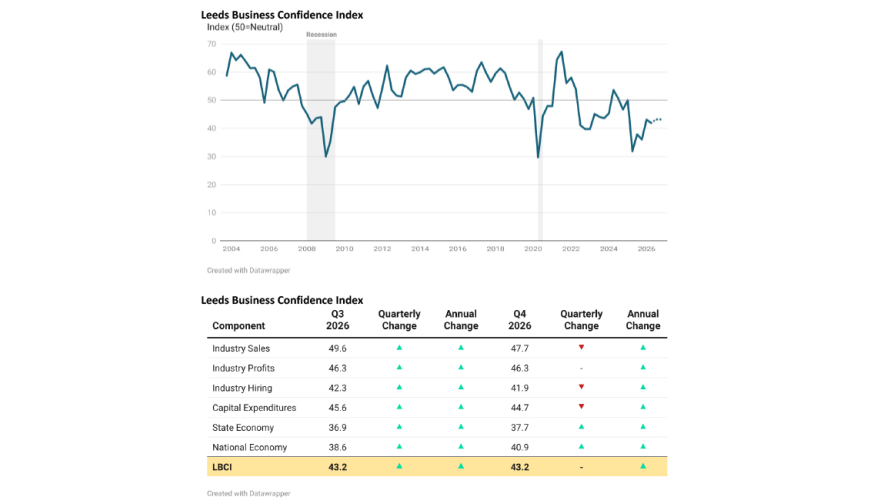
The LEEDS Business Confidence Index by component. Courtesy of LEEDS Business School, University of Colorado, Boulder.
The LEEDS Business Confidence Index by component. Courtesy of LEEDS Business School, University of Colorado, Boulder.
Colorado business confidence improves slightly ahead of Q3
ColoradoBiz Staff //July 2, 2026//



In Brief:
- Leeds Business Confidence Index rises from 41.9 to 43.2
- 214 Colorado business leaders surveyed in June
- Inflation and political instability cited by over one-third
- State economy remains lowest-rated component for fifth quarter
Colorado business leaders reported a modest improvement in confidence heading into the third quarter of 2026, though expectations remained below neutral as inflation, political uncertainty and global conflicts continued to weigh on the outlook.
The Leeds Business Confidence Index, produced by the Business Research Division at the University of Colorado Boulder’s Leeds School of Business, rose from 41.9 in the second quarter to 43.2 for the third quarter. All six components of the index improved from both the previous quarter and a year earlier, but all remained below the neutral benchmark of 50. The survey included responses from 214 business leaders collected between June 1 and June 19.
Inflation, interest rates and general cost pressures were the most frequently cited concerns, identified by 35% of respondents. Political and policy instability followed at 34%, while 23% cited geopolitical events and global conflict. Nearly two-thirds of respondents, or 63%, said risks to their 2026 outlook remain weighted to the downside.
“The incremental increase in the outlook is encouraging, but the index illustrates the ongoing headwinds businesses are experiencing,” said Brian Lewandowski, executive director of the Leeds Business Research Division.
The largest quarter-over-quarter gains were in expectations for the national and Colorado economies. The national economy component increased from 35.4 to 38.6, while the state economy rose from 34.7 to 36.9. Despite the improvement, the state economy remained the lowest-rated component for the fifth consecutive quarter. Industry sales remained the strongest category at 49.6, just below neutral.
Business leaders expect overall confidence to remain unchanged in the fourth quarter, with the index forecast to stay at 43.2. Expectations for the state and national economies improved slightly, while projections for industry sales, hiring and capital expenditures declined modestly.
The report also asked respondents about Colorado’s regulatory environment. More than half rated the state’s regulatory burden as high or very high, while 68% said Colorado’s regulations are more burdensome than those of neighboring states. Respondents identified taxation and fiscal policy, permitting and development requirements, and energy and environmental regulations as the state’s top regulatory challenges.
Recent economic data showed mixed results. Inflation in the Denver-Aurora-Centennial region increased 5% year over year in May, compared with the national rate of 4.2%. Colorado employment was nearly unchanged over the same period, while the state’s real gross domestic product grew at an annualized rate of 1.4% in the first quarter of 2026.
t