Upcoming Event
 Free Newsletter

Report: Denver construction costs rise 10.37% outpacing national growth
ColoradoBiz Staff //June 4, 2026//
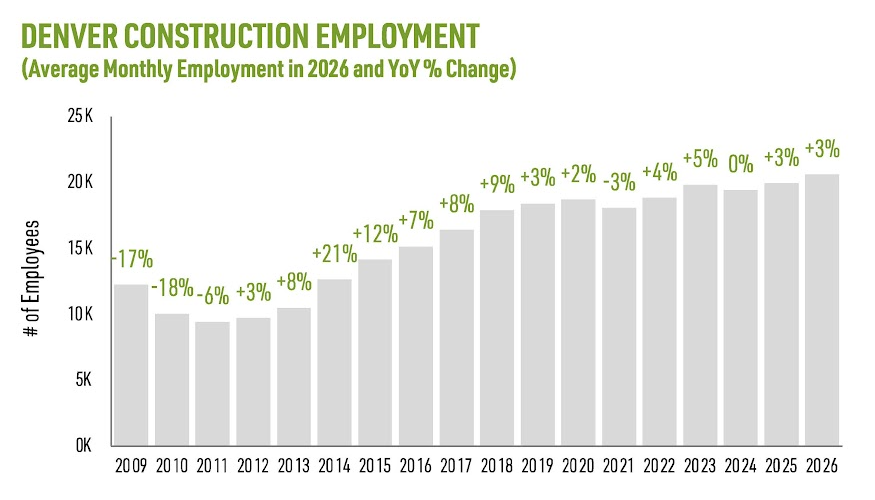
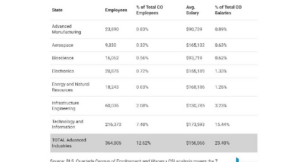
Denver construction employment figures, courtesy of Mortensen.
Denver construction employment figures, courtesy of Mortensen.
Report: Denver construction costs rise 10.37% outpacing national growth
ColoradoBiz Staff //June 4, 2026//



In Brief:
- Mortenson reports 10.37% year-over-year cost increase in Denver
- Denver construction costs rose 2.44% in first quarter
- Construction employment in Denver up 3% to 20,600 workers
- Data centers and healthcare drive strong project planning activity
DENVER — Construction costs in the Denver market increased 10.37% year over year in the first quarter of 2026, outpacing the national increase of 6.77%, according to Mortenson’s Denver Construction Cost Index.
The report found that project planning and development activity remains strong across several sectors, including healthcare, infrastructure, energy and data centers, despite continued pressure from material costs, labor availability and equipment constraints.
Construction costs in Denver rose 2.44% during the first quarter, compared with a national increase of 1.69%. Mortenson attributed the higher costs to demand for steel, copper, aluminum and petroleum-based products, along with ongoing investment in large-scale data centers and manufacturing projects.
“Construction starts increased 13% in March, driven by continued strength in nonresidential activity,” the report said, citing data from the Dodge Construction Network.
Denver’s construction market continues to face pressure from large healthcare, stadium and infrastructure projects that are competing with data center developments for labor and materials. The report said demand is extending lead times for mechanical and electrical equipment, power infrastructure and other critical construction components.
Construction employment in the Denver metro area averaged 20,600 workers during the first quarter, a 3% increase from the same period in 2025. Despite labor pressures, overall workforce conditions have stabilized, according to the report.
Supply chain conditions have improved compared with previous years, though transportation costs, tariffs and energy-related expenses continue to affect pricing. Long-lead electrical and power-distribution equipment remains constrained in several markets.
The report found notable increases in some material categories over the past two years, including copper pipe (up 41%), copper wire (up 31%), lumber (up 15%) and structural steel (up 12%).
Mortenson said planning activity remains elevated across key sectors, particularly data centers, healthcare, energy and infrastructure. The report also noted that the American Institute of Architects’ Architectural Billings Index moved into positive territory for the first time in nearly three years, signaling potential growth in project activity later in 2026.
“A few strong categories overcame slight weakness in all the others in March,” Dodge Construction Network Chief Economist Eric Gaus said in the report. “The commercial segment shows the most strength with 12-month growth for all sub-categories except warehousing.”
Mortenson said the construction market remains active but uneven, with project outcomes increasingly influenced by procurement strategies, equipment availability and market-specific conditions. Forward-looking indicators, including planning activity, construction starts and architectural billings, point to renewed momentum entering the second half of 2026.
i