Upcoming Event
 Free Newsletter

US factory production flat in May as AI investment supports manufacturing
Lucia Mutikani
Reuters //June 15, 2026//
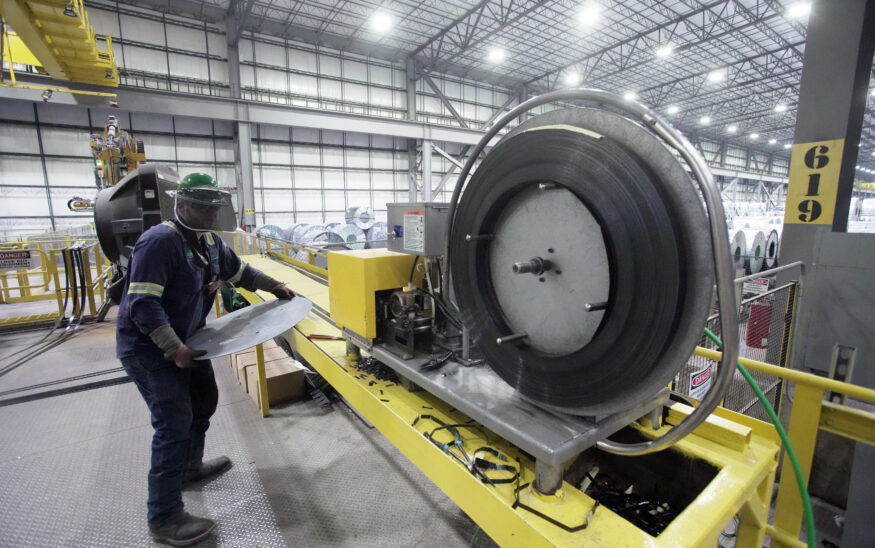
An employee works inside a Nucor steel factory in Blytheville, Arkansas, U.S., March 28, 2025. REUTERS/Karen Pulfer Focht
An employee works inside a Nucor steel factory in Blytheville, Arkansas, U.S., March 28, 2025. REUTERS/Karen Pulfer Focht
US factory production flat in May as AI investment supports manufacturing
Lucia Mutikani
Reuters //June 15, 2026//



In Brief:
- U.S. factory production unchanged in May
- AI spending boosts manufacturing output
- New York Fed reports longer delivery times
- Manufacturing output up 1.4% year-over-year
WASHINGTON (Reuters) – U.S. factory production was unexpectedly unchanged in May after gains in the prior months, which some economists said were related to businesses building up inventory in anticipation of shortages and higher prices due to the war in the Middle East.
Despite the flat reading in output reported by the Federal Reserve on Monday, a business artificial intelligence spending boom is offering a lifeline to manufacturing, helping to offset some of the drag from import tariffs and the recent oil price shock. Business tax incentives for equipment investment are also supporting the sector.
A separate survey from the New York Fed showed delivery times at factories in New York state lengthened further in June, with its measure of supply availability slumping to a four-year low. The U.S. and Iran said on Sunday they had agreed on terms to end the war and reopen the Strait of Hormuz, though the pact may hinge on an end to hostilities in Lebanon.
“Many businesses have feared since February that the sudden closure of the Strait of Hormuz would trigger supply chain disruptions later this year, and so placed orders with manufacturers early,” said Samuel Tombs, chief U.S. economist at Pantheon Macroeconomics.
Manufacturing output increased by an upwardly revised 0.7% in April. Production rose 0.2% in March after accelerating 0.7% in February. Economists polled by Reuters had forecast production in the sector, which accounts for 9.4% of the economy, would increase 0.2% after a previously reported 0.6% surge in April.
Output at factories increased 1.4% on a year-over-year basis in May. Output of long-lasting manufactured goods increased 0.8%, with motor vehicles and parts production advancing 1.2% after rebounding 3.3% in April. Output of computer and electronic products rose 0.9%, and was up 10.3% on a year-over-year basis.
Electrical equipment, appliances, and components production increased by 0.5%. Production of communications equipment rose 0.7% while that of semiconductors and related electronic components increased 2.4% after advancing 2.8% in April. Output of these goods surged 14.4% on a year-over-year basis.
AI spending contributed to the economy’s 1.6% annualized growth pace in the first quarter.
“While much of this investment is imported, domestic production of these goods has also been rising and will likely continue to boost total manufacturing activity in coming months,” said Veronica Clark, an economist at Citigroup.
Non-durable Goods Production Falls
There were also solid increases in the production of wood and nonmetallic mineral products last month as well as primary metals, fabricated metal products, aerospace and miscellaneous transportation equipment, and furniture and related products.
But the strength was offset by a 0.9% decline in the production of non-durable goods. Output of food, beverage and tobacco products fell 0.5%. There were also decreases in the production of petroleum and coal products, chemicals, and plastics and rubber products.
The New York Fed’s Empire State Manufacturing Survey showed its measure of general business conditions dropped about 14 points to 5.7 this month, with a further deterioration in delivery performance and worsening of supply availability. The survey’s measure of future selling prices jumped to its highest level since 2022, suggesting “firms widely expect to raise their prices over the next six months.”
Stocks on Wall Street were trading sharply higher. The dollar eased against a basket of currencies. U.S. Treasury yields fell.
Mining production increased 1.3% last month after gaining 0.2% in April, the Fed report showed. Energy production edged up 0.1%, though oil and gas well drilling rebounded 5.0% after declining for two consecutive months. A retreat in oil prices could curb further gains.
Utilities production fell 0.4% after shooting up 2.2% in April. Overall industrial production nudged up 0.1% after rebounding 0.9% in April. Industrial output increased 1.7% on a year-over-year basis in May.
Capacity utilization for the industrial sector, a measure of how fully firms are using their resources, ticked up to 76.2% from 76.1% in April. It is 3.2 percentage points below its 1972–2025 average. The operating rate for the manufacturing sector was unchanged at 75.7%. It is 2.5 percentage points below its long-run average.
“The resolution of the war, if it sticks, will reduce the drag from uncertainty on business investment decisions, while tailwinds from AI and fiscal policy keep certain sectors buoyant,” said Matthew Martin, senior U.S. economist at Oxford Economics. “In addition, the inventory cycle will turn this year, supporting new orders growth for factories.”
(Reporting by Lucia Mutikani; Editing by Paul Simao)
P