Upcoming Event
 Free Newsletter


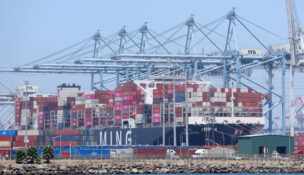
The Long Beach Container Terminal is shown at the Port of Long Beach as seen from Signal Hill, California, U.S., January 14, 2026. REUTERS/Mike Blake
The Long Beach Container Terminal is shown at the Port of Long Beach as seen from Signal Hill, California, U.S., January 14, 2026. REUTERS/Mike Blake
US equipment spending rises on AI boom, housing lags
Lucia Mutikani
Reuters //February 18, 2026//



WASHINGTON (Reuters) – New orders for key U.S.-manufactured capital goods increased more than expected in December, and shipments of these products surged, pointing to solid business spending on equipment and economic growth in the fourth quarter.
In Brief:
- Core U.S. capital goods orders rose 0.6% in December, topping forecasts.
- AI investment and data center demand are boosting equipment spending.
- Factory production increased 0.6% in January, the largest gain in 11 months.
- Housing data was mixed as starts rose, but permits and sentiment weakened.
The strength in the so-called core capital goods orders at the end of the year, reported by the Commerce Department on Wednesday and likely driven by an artificial intelligence investment boom, laid the foundation for sustained economic growth in 2026, economists said.
That was reinforced by other data showing factory production increased the most in 11 months in January, though December output was revised down. AI investment has supported certain segments of manufacturing, and economists are hopeful of a broader recovery as some of the drag from President Donald Trump’s sweeping tariffs fades and tax cuts take effect.
“The ongoing tech investment boom is one of the key factors underlying our sanguine outlook for equipment spending this year,” said Bernard Yaros, lead U.S. economist at Oxford Economics. “Tax cuts and interest-rate relief will broaden investment gains beyond AI-adjacent sectors.”
Non-defense capital goods orders excluding aircraft, a closely watched proxy for business spending, rose 0.6% after an upwardly revised 0.8% increase in November, the Commerce Department’s Census Bureau said. Economists polled by Reuters had forecast core capital goods orders climbing 0.4% after a previously reported 0.4% gain in November.
Core capital goods orders advanced 3.5% year-on-year. AI has fueled rapid growth in data centers, also driving strong demand for equipment beyond technology goods, though tariffs remain a major constraint on manufacturing, which accounts for about 10.1% of the economy.
Orders for fabricated metal products surged 0.9%, while those for electrical equipment, appliances and components rose 0.6%. Machinery orders gained 0.3%. Orders for computers and electronic products soared 3.0%.
Primary metals orders shot up 1.7%. Shipments of core capital goods jumped 0.9% after climbing 0.2% in November.
The report, delayed by last year’s government shutdown, was published ahead of the advance estimate of fourth-quarter gross domestic product on Friday.
Business spending on equipment is forecast to have notched a fourth straight quarter of growth.
The economy likely grew at a 3.0% annualized rate in the fourth quarter after expanding at a 4.4% pace in the July-September quarter, a Reuters survey of economists showed.
Orders for durable goods, items ranging from toasters to aircraft meant to last three years or more, decreased 1.4% in December after soaring 5.4% in November. The decline reflected a 24.9% drop in orders for the volatile non-defense aircraft and parts. Boeing reported on its website that it had received 175 aircraft orders in December, the bulk of them less-expensive models, compared with 164 in November.
Motor vehicle orders rebounded 1.2%.
The manufacturing improvement was evident in a separate report from the Federal Reserve showing factory production rose 0.6% in January, the largest gain since February 2025. Data for December was revised down to show output being unchanged instead of rising 0.2% as previously reported. Factory production advanced 2.4% on a year-over-year basis in January.
Manufacturing is not yet out of the woods, with 83,000 jobs lost since January 2025. Trump has defended his punitive import duties as necessary to restore a long-declining domestic industrial base.
“Manufacturing production is higher than year-ago levels, but it was all done without additional workers,” said Christopher Rupkey, chief economist at FWDBONDS. “Robots and automated production processes could be to blame. It is no good to bring factories back to America if workers do not benefit due to the productivity miracle that helps no one.”
Stocks on Wall Street were trading higher. The dollar gained versus a basket of currencies. U.S. Treasury yields rose.
Housing Market Remains On The Back Foot
News on the housing market was mixed. In a third report, the Census Bureau said single-family housing starts, which account for the bulk of homebuilding, increased 4.1% to a seasonally adjusted annual rate of 981,000 units in December. Single-family starts rose to a pace of 942,000 units in November, up from 894,000 in October.
Tariffs on imported goods, including lumber and vanity cabinets, have raised material prices, while worker shortages amid an immigration crackdown are contributing to higher building costs, constraining activity.
Starts for housing projects with five units or more soared 10.1% to 402,000 units.
Overall housing starts jumped 6.2% to a rate of 1.404 million units, the highest level since July, after rising in November to a pace of 1.322 million units.
Permits for future single-family homebuilding slipped 1.7% to a rate of 881,000 units. They rose to a pace of 896,000 units in November, up from 878,000 units in October.
Sentiment among single-family homebuilders deteriorated further in February, a survey from the National Association of Home Builders showed on Tuesday, with builders citing persistently high land and construction costs, as well as still-elevated house prices relative to incomes, as constraints.
The Trump administration has implemented a raft of measures, including purchases of mortgage-backed securities and banning institutional investors from buying single-family homes, to improve housing affordability. Though mortgage rates have eased, progress has stalled as worries over federal government debt have kept U.S. Treasury yields elevated.
Mortgage rates track the 10-year Treasury yield. Economists and realtors say more supply is needed to make housing more affordable.
Building permits for the volatile multi-family housing segment vaulted 18.1% to a rate of 515,000 units, the highest since August 2023. Overall building permits increased 4.3% to a rate of 1.448 million units, a nine-month high.
Residential investment, which includes homebuilding, is expected to have contracted for a fourth straight quarter.
“A more significant decline in mortgage rates would be needed to more meaningfully boost housing market activity,” said Gisela Young, an economist at Citigroup.
(Reporting by Lucia Mutikani; Editing by Chizu Nomiyama and Andrea Ricci)
t