Upcoming Event
 Free Newsletter

US single-family housing starts fall amid lowest permits in 10 months
Lucia Mutikani
Reuters //July 17, 2026//
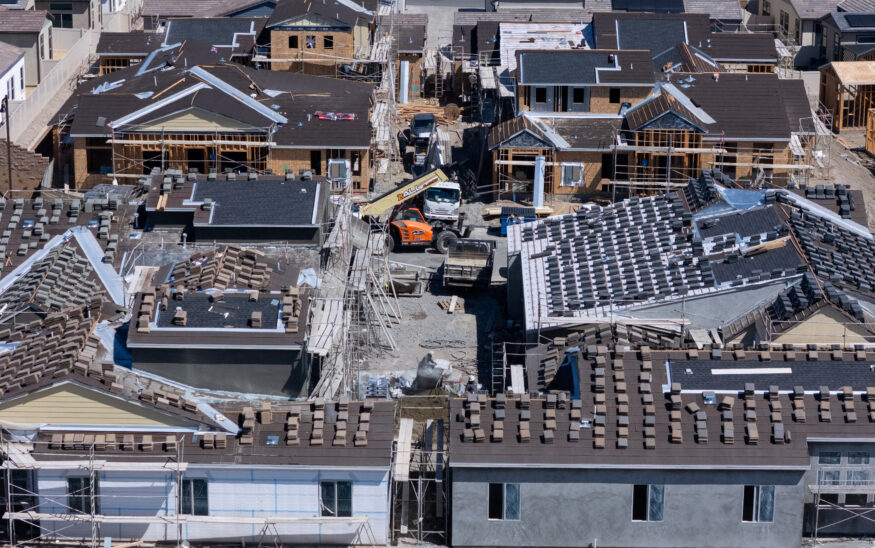
A drone view shows new single family home construction in San Diego, California, U.S., March 25, 2025. REUTERS/Mike Blake
A drone view shows new single family home construction in San Diego, California, U.S., March 25, 2025. REUTERS/Mike Blake
US single-family housing starts fall amid lowest permits in 10 months
Lucia Mutikani
Reuters //July 17, 2026//



In Brief:
- Single-family housing starts fell 0.2% to 895,000 units
- Permits dropped 2.4% to lowest level since August 2025
- Multi-family housing starts surged 76.3% in June
- Mortgage rates reached 11-month high of 6.55%
WASHINGTON (Reuters) – U.S. single-family homebuilding fell for a third straight month in June while permits for future construction dropped to the lowest level in 10 months, weighed down by higher mortgage rates and a glut of unsold new homes on the market.
Homebuilding is also constrained by rising land and material costs. Builders and economists said it would take a while for the housing market to benefit from a bipartisan housing affordability legislation recently passed by the U.S. Congress, which, among other provisions, waives or speeds up environmental reviews for construction projects.
The bill became law despite President Donald Trump not signing it, demanding that a separate voting bill be passed.
“The potential uplift to housing starts from streamlining environmental reviews, easing rules on manufactured housing and encouraging zoning reform will take time to filter through,” said Samuel Tombs, chief U.S. economist at Pantheon Macroeconomics. “Real residential investment will drag modestly on GDP growth over the coming quarters.”
Single-family housing starts, which account for the bulk of homebuilding, slipped 0.2% to a seasonally adjusted annual rate of 895,000 units, the Commerce Department’s Census Bureau said on Friday. Starts fell in the Northeast, the South and Midwest, but rose in the West. Single-family homebuilding dropped 3.2% year-on-year in June.
Permits for future construction of single-family homes fell 2.4% to 871,000 units, the lowest level since August 2025. They fell 0.2% year on year in June.
There is limited scope for a strong rebound in permits, as elevated mortgage rates sideline potential homebuyers.
The rate on the popular 30-year fixed mortgage has increased by nearly 60 basis points since the U.S. and Israel attacked Iran at the end of February. The rate averaged an 11-month high of 6.55% this week, data from mortgage finance agency Freddie Mac showed, as oil prices swung wildly amid a shaky ceasefire between the U.S. and Iran.
The brief lull in hostilities did boost consumer sentiment in early July across all age and income groups and political party affiliations, a separate report showed. The University of Michigan’s consumer survey was conducted from June 23 to July 13, with more than 70% of interviews completed before the resumption of hostilities in the Middle East.
“Renewed uncertainty surrounding the U.S.-Iran conflict could keep energy prices volatile and weigh on household finances and perceptions of the economy, delaying a broader improvement in consumer sentiment,” said Vivian Chen, financial markets economist at Nationwide.
Stocks on Wall Street were trading lower amid a tech share rout. The dollar was steady against a basket of currencies. U.S. Treasury yields fell.
National Housing Shortage
A National Association of Home Builders survey on Thursday showed sentiment among single-family homebuilders remained depressed in July. Though there is a national housing shortage, especially for starter homes, the stock of unsold new homes on the market is back near levels last seen in late 2007 because of a poor spring selling season this year.
“It felt like builders were finally getting a handle on their inventories, but the clunker of a spring selling season set them back again,” said Stephen Stanley, chief U.S. economist at Santander U.S. Capital Markets. “As a result, while the level of real residential construction activity should level off soon, the extended downturn that has been in place for two years may extend the weakness for another quarter or two.”
Starts for housing projects with 5 units or more, a very volatile segment, soared 76.3% to 513,000 units in June. Multi-family housing starts increased 19.3% year on year. Overall, housing starts jumped 19.0% to a pace of 1.427 million units. They increased 3.5% year on year in June.
Building permits for multi-family housing projects dropped 4.9% to 445,000 units last month. Overall, building permits fell 3.0% to 1.367 million units. They declined by 2.3% year on year in June.
The housing drag on the economy was likely offset by strength in consumer spending and business investment in equipment, thanks to an ongoing artificial intelligence build-out and inventory restocking as firms sought to avoid shortages and higher prices related to the Middle East conflict.
A third report from the Federal Reserve showed manufacturing output unchanged in June. Production at factories, however, grew at a 4.7% annualized rate in the second quarter, the fastest in five years. The report also showed increased utilities production, which feeds into consumer spending.
Economists at Goldman Sachs raised their second-quarter gross domestic product estimate to a 2.5% rate from a 2.4% pace.
Though reports this week showed price pressures ebbed in June, inflation is far from being contained.
A fourth report from the Labor Department’s Bureau of Labor Statistics showed an unexpected 0.3% increase in import prices in June, as higher prices for capital and consumer goods more than offset declines in the costs of food and energy products. Economists had forecast that import prices, excluding tariffs, would decrease by 0.7%.
In the 12 months through June, import prices surged 7.1%, the biggest advance since August 2022. It followed a 6.6% increase in May. Excluding food and fuels, import prices increased 0.4%. Core imported inflation rose 4.6% in the 12 months through June, boosted by a 0.4% increase in capital goods prices. This reflected strong demand for AI-related technology products.
Prices for computer peripherals and parts rose 2.3% over the month and surged 41.6% year-over-year. The AI buildout is helping to lift overall core inflation.
The report also showed a jump in international airfares, a category that goes into the calculation of the core Personal Consumption Expenditure Price Index, one of the measures the U.S. central bank tracks for its 2% inflation target.
“For the Fed, it’s a reminder that cost pressures for underlying goods have not disappeared even as consumer inflation cooled in June,” said Priscilla Thiagamoorthy, senior economist at BMO Capital Markets.
(Reporting By Lucia Mutikani; Editing by Chizu Nomiyama, Nick Zieminski and David Gregorio)
e