Upcoming Event
 Free Newsletter

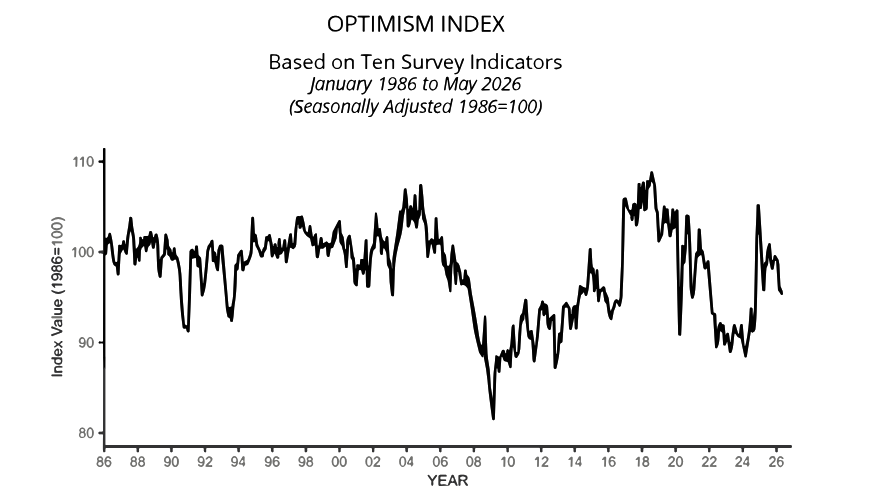
Small business optimism index, courtesy of NFIB.
Small business optimism index, courtesy of NFIB.
Small business optimism declines as hiring plans weaken
ColoradoBiz Staff //June 9, 2026//



In Brief:
- NFIB optimism index falls to 95.3 in May
- Job openings drop to lowest since May 2020
- Labor costs cited as top concern by 14% of owners
- Capital spending plans at lowest since March 2009
DENVER — Small business optimism slipped in May as hiring plans, job openings and expansion plans fell, according to a survey released Tuesday by the National Federation of Independent Business.
The NFIB Small Business Optimism Index fell 0.6 points to 95.3 in May, remaining below its 52-year average of 98.0. The group’s Uncertainty Index rose 3 points to 91, well above its historical average of 68.
The NFIB Small Business Employment Index was essentially unchanged at 100.3 in May, down slightly from 100.4 in April and below the 2025 average of 101.2.
Job openings continued to ease. A seasonally adjusted 29% of small business owners reported positions they could not fill, down 5 percentage points from April and the lowest level since May 2020. A net 9% of owners said they plan to create new jobs over the next three months, down 4 points from April and also the lowest level since May 2020.
“AI investment spending has contributed to some excitement in the economy,” NFIB Chief Economist Bill Dunkelberg said. “Despite the enthusiasm around AI, the overall picture is divided.”
Dunkelberg said many small business owners are struggling with rising fuel costs that are difficult to pass on to customers.
Labor concerns shifted in May. Thirteen percent of owners identified labor quality as their most important business problem, down 5 points from April and the lowest level since December 2016. At the same time, 14% cited labor costs as their top concern, up 5 points from April and the highest level recorded in the survey’s history.
“The cost of running a small business is continuing to climb,” NFIB State Director Michael Smith said. “Whether it’s labor, fuel, or credit card swipe fees, small business owners are feeling pressure from every direction.”
Capital spending plans also weakened. Sixteen percent of owners said they plan to make capital outlays in the next six months, down 1 point from April and the lowest level since March 2009.
Supply chain disruptions increased during the month, with 70% of owners reporting some impact on their business, up 6 points from April. Reports of moderate and mild disruptions both increased.
Inflation remained a major concern. Eighteen percent of owners cited inflation as their most important business problem, up 2 points from April and the highest level since December 2024. The share of owners raising average selling prices increased 6 points to a net 36%, the highest reading since March 2023. A net 34% said they plan to raise prices in the next three months, the highest level since July 2022.
The survey found business owners remain cautious about future growth. The share of owners who said it is a good time to expand their business remained at 7%, the lowest level since October 2024, while expectations for better business conditions fell for the fifth consecutive month.
The NFIB Research Center conducted the survey in May, receiving 504 responses from a sample of 5,000 small business owners.
g