Upcoming Event
 Free Newsletter

Colorado’s deadliest highway stretches revealed
Brian Beltz
Director of Research and Content Strategy at 1Point21 Interactive //November 7, 2025//
Colorado’s deadliest highway stretches revealed
Brian Beltz
Director of Research and Content Strategy at 1Point21 Interactive //November 7, 2025//



DENVER — Colorado’s scenic highways link its growing cities with mountain towns and outdoor destinations, but some of those same routes are also among the most dangerous in the state. A new analysis of fatal crash data shows several 10-mile stretches of interstate consistently rank as the deadliest for motorists, revealing where safety concerns are most urgent.
In Brief:
- I-70 in northeast Denver recorded the most fatal crashes in Colorado from 2019–2023.
- I-25 corridors through Denver, Colorado Springs, and Pueblo also ranked among the deadliest.
- Nearly 22% of deadly crashes on top stretches involved pedestrians, highlighting urban safety risks.
- Researchers used NHTSA fatality data to map 10-mile segments with the highest crash concentrations.
The study, based on National Highway Traffic Safety Administration data from 2019 to 2023, examined fatal crashes across Colorado using a rolling 10-mile window to identify the highway segments with the highest number of deadly collisions.
Denver Metro Area Leads in Fatal Stretches
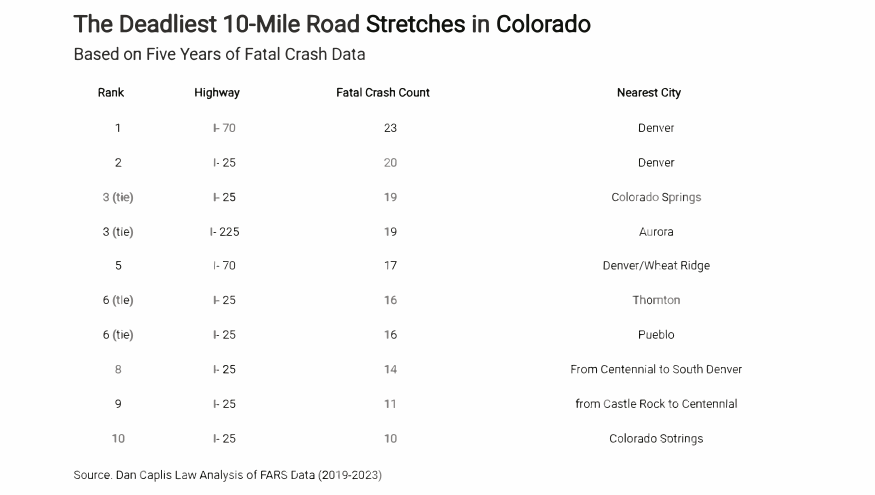
The deadliest 10-mile stretch in the state lies along Interstate 70 in northeast Denver, beginning around Northfield Quebec Street and running east to E-470. That segment recorded 23 fatal crashes over five years, the highest total in Colorado.
The second-deadliest section runs through central Denver on Interstate 25, from West 84th Avenue south to the West 6th Avenue Freeway. The busy corridor, which cuts through downtown and the Mariposa District, saw 20 fatal crashes.
Another high-risk stretch of I-70 extends from Denver West Marriott Boulevard in Wheat Ridge to Tejon Street in Denver, recording 17 fatal crashes. The route serves as a main link to popular recreation spots such as Red Rocks Park and Amphitheatre.
Outside I-25 and I-70, Interstate 225 in Aurora ranks among the most dangerous segments, with 19 fatal crashes between East Smith Road and South Yosemite Street.
To the north, a 10-mile stretch of I-25 through Thornton, from East 168th Avenue to West 92nd Avenue, recorded 16 fatal crashes. South of Denver, two more I-25 sections ranked in the top 10 statewide. One, from East Lincoln Avenue to East Yale Avenue, saw 14 deadly crashes, while another near Castle Rock recorded 11.
Colorado Springs and Pueblo Fatalities
In Colorado Springs, two adjoining stretches of I-25 were among the deadliest. One, from Mesa Ridge Parkway to West Bijou Street, recorded 19 fatal crashes and tied for third place statewide. The corridor serves both civilian and military drivers traveling to and from Fort Carson. The second, extending north toward Briargate Parkway near the U.S. Air Force Academy Airfield, ranked tenth with 10 fatalities.
Further south, I-25 in Pueblo between West Pueblo Boulevard and Quartz Road logged 16 fatal crashes, tying for sixth statewide. Although traffic volumes there are lower than in the Denver metro area, a recent transportation report found that 37 percent of Pueblo’s major roads are in poor condition, contributing to safety risks.
Urban Areas Most at Risk
The analysis found that the most deadly road stretches are located in urban areas, where higher population density and mixed traffic create more hazards. Nearly 22 percent of fatal crashes on Colorado’s most dangerous 10-mile segments involved a pedestrian, compared with 7 percent of other fatal crashes statewide.
The data suggests that the state’s most perilous highways are not only busy but also shared with pedestrians and cyclists, underscoring the need for infrastructure improvements and stronger safety measures.
Methodology
The analysis used data from the Fatality Analysis Reporting System, a federal database maintained by the National Highway Traffic Safety Administration. Researchers reviewed all fatal crashes on Colorado roadways from 2019 through 2023 and mapped them using a moving 10-mile window to identify the sections with the highest fatality concentrations.
The findings highlight the continued challenge of balancing mobility and safety across Colorado’s expanding highway network as population growth and tourism increase traffic statewide.
Brian Beltz is the Director of Research and Content Strategy at 1Point21 Interactive, where he transforms complex data into compelling visual narratives. Working alongside Dan Caplis Law Firm, Brian’s team analyzed thousands of Colorado traffic incidents to provide valuable insights for drivers and accident victims.
l