Upcoming Event
 Free Newsletter

Colorado residents face rising living costs and tough financial tradeoffs
Margaret Jackson //August 13, 2026//
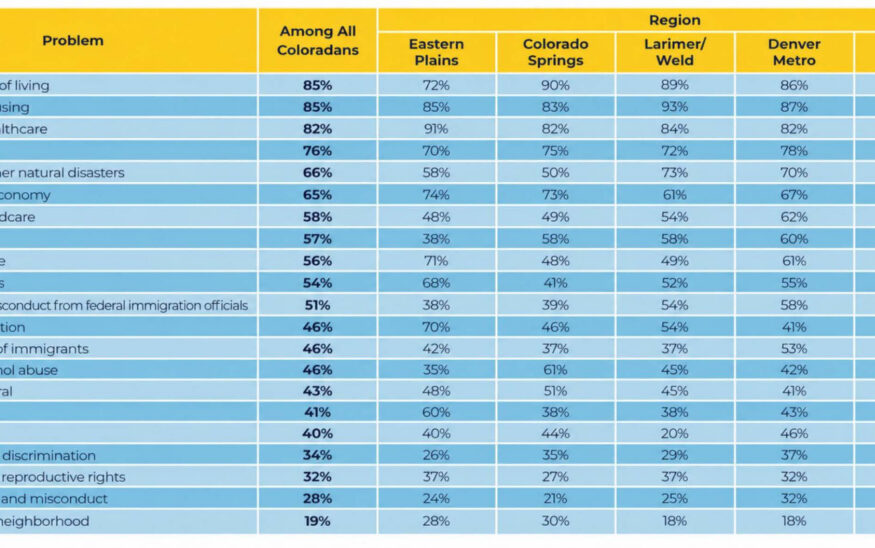
Cost issues rank highly in every part of the state. Graph courtesy of The Colorado Health Foundation.
Cost issues rank highly in every part of the state. Graph courtesy of The Colorado Health Foundation.
Colorado residents face rising living costs and tough financial tradeoffs
Margaret Jackson //August 13, 2026//



In Brief:
- More than 85% of Coloradans cite cost of living as top concern
- Small Business Majority highlights challenges for 750,000 small businesses
- Survey finds 17% skipped meals and 32% worry about housing loss
- Healthcare premiums expected to rise 13.4%, straining businesses
Rising living costs are reshaping daily life across Colorado, forcing people to make painful financial tradeoffs and raising questions about the state’s long-term affordability.
Persistent economic pressures – spiking during the pandemic – have reached peak levels, according to the seventh annual Colorado Health Foundation Pulse Poll.
Cost of living and housing are the top concerns for more than 85% of residents.
The squeeze is particularly intense for younger generations: 90% of Gen Z and 94% of millennials say housing costs are a serious problem, while 76% of Coloradans worry about whether they can afford to live in the state in the future.
The economic strain extends to the state’s business community. With nearly 750,000 small businesses operating across Colorado, owners face a dual crisis – ballooning operational costs and a struggling workforce.
“Colorado’s small-business owners are navigating a perfect storm of economic challenges,” said Hunter Nelson of the Small Business Majority in Colorado. “When workers can’t afford to live in the communities where they work or access the healthcare they need, it creates real challenges for recruitment, retention and long-term growth.”
Small group health insurance premiums face a preliminary 13.4% rate increase, further straining business owners who want to support their staff, Nelson said.
The survey of 2,240 adults found Colorado residents are making painful tradeoffs:
- 17% reported skipping meals in the past year because they could not afford food, and 31% worry about affording enough food in the year ahead.
- Nearly half postponed medical or dental care in the last year.
- 42% are worried that they or someone in their household will be without health coverage in the coming year.
- 32% said they are worried about losing their home in the coming year because they can’t afford their rent or mortgage.
- 29% delayed mental health treatment.
- 22% skipped or made a late utility payment.
- 73% cut back on recreation and entertainment spending.
- 55% reduced their charitable giving.
Economic pressures also are rippling through Colorado’s cultural and tourism ecosystems.
“Small business plays a huge cultural role in our communities,” Nelson said. “Working in a coffee shop, getting together at a restaurant – when small businesses can’t afford to stay here, we lose those cultural pieces of our community, and it affects mental health in terms of connecting with other community members.”
At the same time, the state’s tourism industry – a major economic engine for both mountain communities and urban hubs – faces slowing growth and shifting visitor dynamics as higher travel costs, lodging taxes and daily living expenses make Colorado more costly for locals and tourists.
With 73% of survey respondents cutting back on entertainment and local recreation, resident-supported cultural venues, performance arts and outdoor hospitality businesses face an uncertain future as consumers prioritize paying essential bills over leisure.
“Small businesses play a large role in tourism,” said Katie Peshek, senior communications officer at The Colorado Health Foundation. “There’s a big impact on recreational spending and charitable giving – and it’s not limited to particular income brackets. People across all income brackets are feeling stressed and concerned.”
l