Upcoming Event
 Free Newsletter

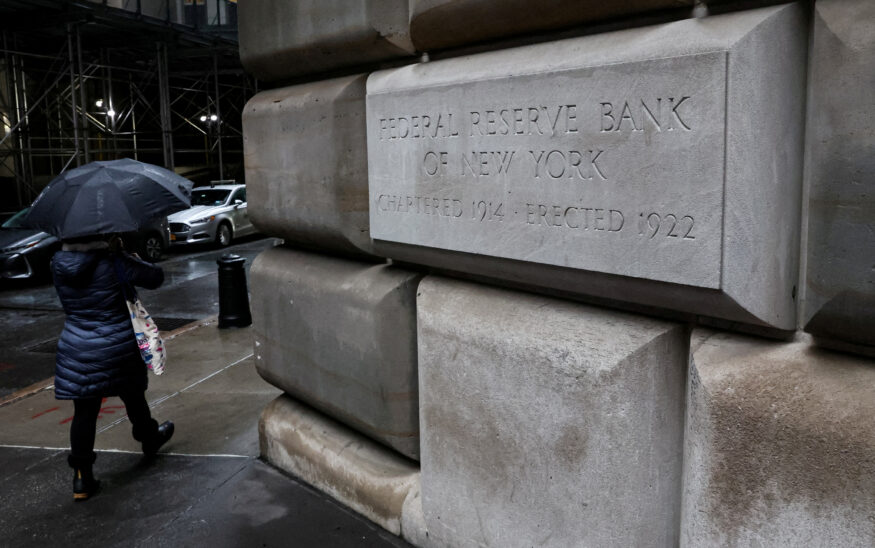
A woman passes by The Federal Reserve Bank of New York in New York City, U.S., March 13, 2023. REUTERS/Brendan McDermid
A woman passes by The Federal Reserve Bank of New York in New York City, U.S., March 13, 2023. REUTERS/Brendan McDermid
New York Fed inflation gauge rises to 2.8%
Michael S. Derby
Reuters //February 23, 2026//



(Reuters) – The underlying level of inflation heated up in December as measured by a New York Federal Reserve gauge, suggesting further challenges in getting overall price pressures back to the U.S. central bank’s 2% target.
In Brief:
- The New York Fed‘s Multivariate Core Trend inflation reading rose to 2.8% in December.
- Service and goods price pressures drove the increase in underlying inflation.
- Persistent inflation concerns have led some Fed officials to oppose rate cuts.
- Supreme Court action on Trump tariffs adds uncertainty to the inflation outlook.
The regional Fed bank said its Multivariate Core Trend inflation reading ticked up to 2.8% in December from 2.4% in the prior month, boosted by price pressures in services outside housing and in goods.
Fed officials expect price pressures to retreat this year as President Donald Trump’s system of large-scale tariff increases exerts a less dramatic impact on inflation.
Much of the overshoot of the central bank’s inflation target has been attributed to Trump’s tariffs, and concerns about price pressures have led several Fed officials to oppose interest rate cuts even as the job market has softened.
The Fed lowered its benchmark overnight interest rate by three-quarters of a percentage point last year to the 3.5%-3.75% range, a level it maintained at its January 27-28 meeting. Markets expect the central bank to cut rates again this year, although Fed officials have provided little guidance about the prospects for further easing.
Supreme Court Decision Adds To Uncertainty
In an appearance on Friday in New York, Dallas Fed President Lorie Logan, who was skeptical of the rate cuts delivered last year given the persistence of inflation over the target, said she was “cautiously optimistic” that, given where monetary policy is now set, “we’re on a path to for inflation to come back down toward our target.”
“My expectation is that some of the tariff effects, particularly in goods inflation, will start to fade,” as a “roughly balanced” job market helps other parts of inflation cool, Logan said.
She noted that the Trimmed Mean Personal Consumption Expenditures rate, another alternative inflation measure produced by the Dallas Fed, is moving in a more favorable direction.
That gauge seeks to better measure inflation by factoring out the biggest positive and negative price changes in a given month. On a year-over-year basis, that reading has steadily cooled to 2.4% in December from 2.8% in August.
But the Trimmed Mean PCE jumped to 2.2% in December versus 1.7% in November on a month-over-month basis.
The centrality of Trump’s tax increases in driving up inflation became less certain after the U.S. Supreme Court on Friday struck down many of his tariffs. The president responded by announcing major new tax increases and potential fees on imports.
The Trump administration has claimed repeatedly that its tax increases are helping the economy. A recent New York Fed report showed the tariffs, contrary to the administration’s claims, are in fact almost entirely borne by U.S. importers and consumers.
(Reporting by Michael S. Derby; Editing by Paul Simao)
n