Upcoming Event
 Free Newsletter

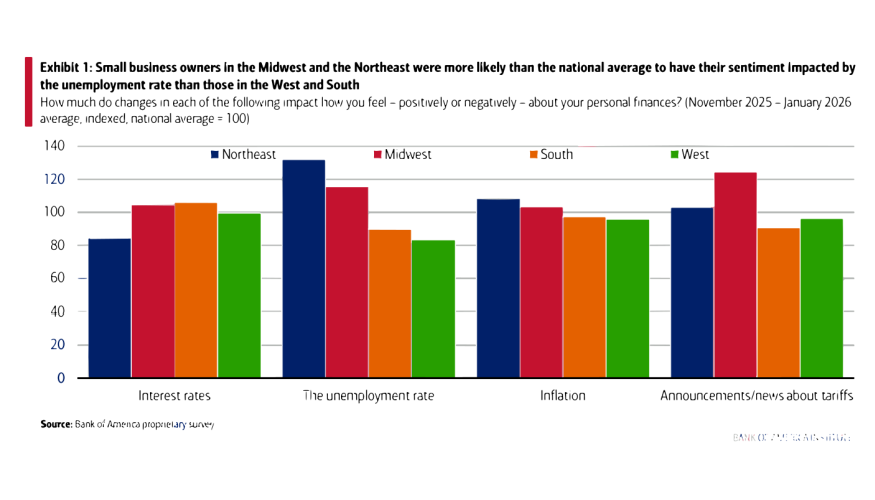
Small business owners in the Midwest and the Northeast were more likely than the national average to have their sentiment impacted by the unemployment rate than those in the West and South. Courtesy of Bank of America.
Small business owners in the Midwest and the Northeast were more likely than the national average to have their sentiment impacted by the unemployment rate than those in the West and South. Courtesy of Bank of America.
Small business optimism cautious as costs rise
ColoradoBiz Staff //February 19, 2026//



Small business owners entered 2026 with cautious optimism, though uncertainty remains elevated, according to a recent Bank of America survey.
In Brief:
- Small business owners entered 2026 cautiously optimistic, though uncertainty remained above historical averages.
- Consumer spending rose 2.6% year over year in January, supporting expectations for higher sales.
- Tariff payments per small business client jumped 142% year over year, pressuring profitability.
- Payroll growth at small firms rose 0.6% year over year while hiring remained subdued.
The survey found small business owners were more concerned than the general population about unemployment, financial markets and interest rates. The January National Federation of Independent Business report showed optimism above the historical average, but uncertainty also above average.
More owners reported improved business health and expected higher sales. Sentiment varied by region and industry. Owners in the Midwest and Northeast were more likely than the national average to say unemployment affected their outlook, while those in the Midwest and South were more sensitive to interest rates.
Consumer spending has provided some support. Bank of America credit and debit card data showed spending rose 2.6% year over year in January, the fastest pace in nearly two years. The increase in expected real sales was a key factor behind improved optimism.
Still, profitability has lagged. Despite stronger discretionary spending in the second half of 2025, small business profit growth moderated. Tariff costs have risen. Tariff payments per small business client were up 142% year over year in January on a three-month moving average. A New York Federal Reserve analysis found that import prices for goods subject to average tariffs rose by 11% more than those for goods not subject to tariffs.
“There just isn’t any evidence out there in the economic research literature to suggest that tariffs have materially impacted trade deficits historically when countries have implemented them,” said Chad Bown, senior fellow at the Peterson Institute for International Economics.
Insurance costs have also increased. In January, 13% of owners cited the cost or availability of insurance as their most important problem, up four points from December, according to NFIB. Tenants’ insurance in the Consumer Price Index rose 8.4% year over year in January on a three-month moving average. Expiring Affordable Care Act subsidies are also expected to affect some small firms.
Small businesses account for 38.7% of private sector payroll, according to the Small Business Administration. Bank of America data showed that payroll growth per small-business client rose 0.6% year over year in January, on a three-month moving average. Payroll levels in 2025 were generally stable, though lower than the 2024 annual average except among small retailers and transportation firms.
Firms with fewer than 50 employees accounted for 50% of job openings in 2025 and 46% of layoffs, according to the Bureau of Labor Statistics Job Openings and Labor Turnover Survey. Those firms were the only group with job openings above 2019 levels.
Larger small businesses increased layoffs and reduced hiring. Payments to hiring firms per small business client improved slightly in January but remained well below year-ago levels.
Overall payments among small business clients rose 3.7% year over year in January, with automated clearing house payments up 3.5%. All major categories, except small-business debit card payments, increased from December.
Bank of America said its analysis is based on aggregated and anonymized transaction data and should be viewed alongside other economic indicators.
n