
Upcoming Event
 Free Newsletter

US chipmakers hit record highs as Intel boosts AI demand
Shashwat Chauhan and Purvi Agarwal
Reuters //April 24, 2026//
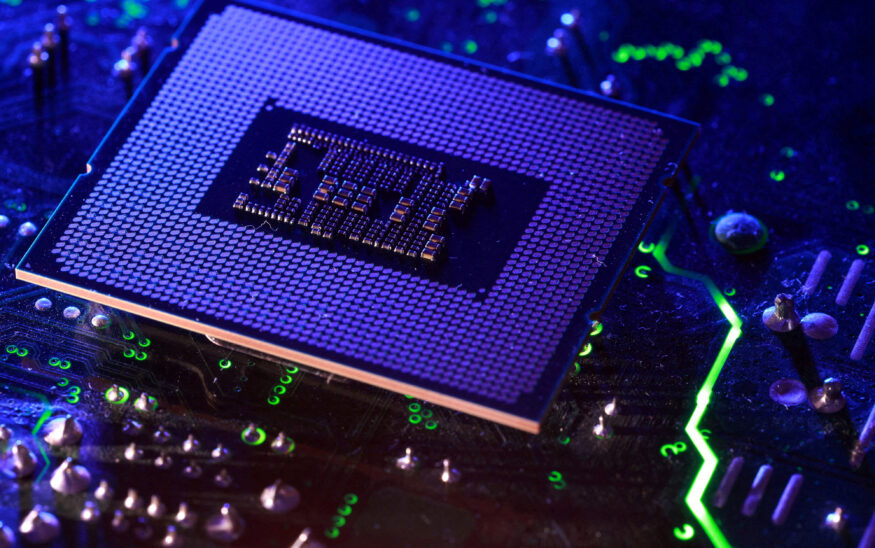
Computer motherboard and Intel chip appear in this illustration taken August 25, 2025. REUTERS/Dado Ruvic/Illustration/File Photo
Computer motherboard and Intel chip appear in this illustration taken August 25, 2025. REUTERS/Dado Ruvic/Illustration/File Photo
US chipmakers hit record highs as Intel boosts AI demand
Shashwat Chauhan and Purvi Agarwal
Reuters //April 24, 2026//



(Reuters) – U.S. chip stocks soared to record highs on Friday as Intel‘s unexpectedly strong revenue forecast reinforced confidence that the AI boom powering this year’s rally in the semiconductor sector is showing no signs of slowing down.
In Brief:
- Philadelphia semiconductor index rises 3.2% to record high
- Intel stock surges 22.6% past dotcom-era peak
- Semiconductors sub-industry earnings growth forecast at 109.2%
- Texas Instruments forecasts second-quarter revenue above estimates
The foremost stock index for chip makers – the Philadelphia SE Semiconductor Index – rose 3.2% to an all-time high and was on track to extend its record-breaking streak of single-day gains to 18. The index has gained more than 47% this year.
Chip stocks have been some of the biggest gainers of the spending spree by tech giants on scaling up their AI infrastructure.
“The AI build-out race is still on. We are seeing solid results, especially for semiconductors and no sign that demand for AI is slowing down,” said Angelo Kourkafas, senior global investment strategist at Edward Jones.
The semiconductors sub-industry alone is expected to record first-quarter earnings growth of 109.2% – much higher than the broader S&P 500 information technology sector whose earnings growth is seen at 48.2%, according to LSEG data.
Demand For CPUs Propels Intel
Intel surged 22.6% to surpass its dotcom-era peak from 2000, following a robust revenue outlook that signaled strong demand for central processors (CPUs) that power how AI models answer user queries.
Rivals AMD and Arm also climbed 13.7% and 12%, respectively.
Nvidia, now the world’s most valuable company, rose 1.6%. Much of last year’s rally in chip stocks was driven by Nvidia, whose gains were fueled by strong demand for its flagship graphics processing units (GPUs) used for tasks such as training models on large datasets.
Edward Jones’ Kourkafas also pointed to renewed enthusiasm for the broader tech sector, especially driven by semiconductors, after a recent dip in valuations.
“Over the last 12 months, tech valuations have cheapened and have come in broadly in line with the overall market,” Kourkafas said.
AI-related and other Big Tech stocks were under pressure earlier this year as investors grew uneasy over huge spending without near-term proof it would translate into faster revenue, stronger margins and higher cash flow.
The S&P 500 information technology index’s price-to-earnings ratio has dropped to around 22 times its 12-month forward earnings from a peak of around 31.8 last year.
Investors Look Past New DeepSeek Model
U.S. tech stocks also seemed to shrug off a preview of a new AI model from Chinese startup DeepSeek, whose low-cost AI model rocked Wall Street last year.
“Over time, people have come to realize that actually they’re not the threat that they seemed to be. The market’s saying, ‘Hang on, we’re not going to be bitten twice with this,'” said David Morrison, senior market analyst at Trade Nation, referring to the threat from DeepSeek.
The Philadelphia chip index was trading around 26.6 times its 12-month forward earnings estimates, compared with around 20.7 for the S&P 500.
Analog chipmaker Texas Instruments also forecast second-quarter revenue and profit above estimates on Wednesday, sending its shares to a record high. It was down 2.8% on Friday.
(Reporting by Shashwat Chauhan and Purvi Agarwal in Bengaluru; Additional reporting by Niket Nishant; Editing by Saumyadeb Chakrabarty)
C