Upcoming Event
 Free Newsletter

US trade deficit widens as capital goods imports hit record high
Lucia Mutikani
Reuters //July 7, 2026//
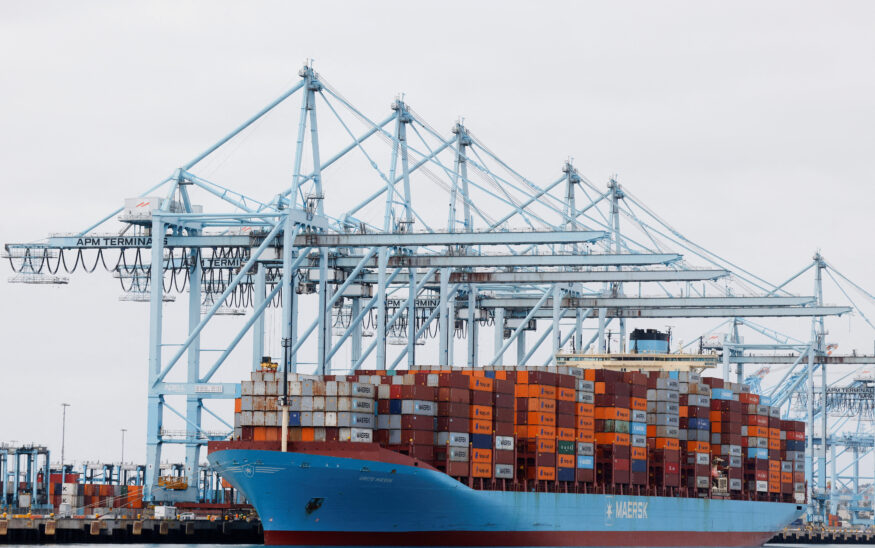
Shipping containers sit on a Maersk vessel docked at the port of Los Angeles in Long Beach, California, U.S., March 10, 2026. REUTERS/Caroline Brehman/File Photo
Shipping containers sit on a Maersk vessel docked at the port of Los Angeles in Long Beach, California, U.S., March 10, 2026. REUTERS/Caroline Brehman/File Photo
US trade deficit widens as capital goods imports hit record high
Lucia Mutikani
Reuters //July 7, 2026//



In Brief:
- US trade deficit jumps 42.2% to $77.6 billion
- Capital goods imports hit record $128 billion in May
- Petroleum exports rise to record $38.4 billion
- Exports drop 3.2% amid strong dollar effects
WASHINGTON (Reuters) – The U.S. trade deficit widened sharply in May as imports of capital goods surged to a record high, suggesting that trade remained a drag on gross domestic product in the second quarter.
Efforts by businesses to avoid shortages and higher prices related to the conflict in the Middle East, as well as potential new tariffs, also contributed to the large trade shortfall, as the Commerce Department‘s report on Tuesday showed overall imports rising to a 14-month high. The U.S.-Israeli war with Iran also boosted oil exports, with shipments of petroleum hitting a record high.
Though imports will likely subtract from economic growth, their persistent strength also signals resilient domestic demand. Imports are partly being driven by an artificial intelligence investment boom. The deficit swelled to a 14-month high despite President Donald Trump’s tariffs on imports.
“Imports convey solid U.S. domestic demand, though inventory frontloading likely lent a hand,” said Oren Klachkin, financial market economist at Nationwide. “AI investment appears to remain on a very solid track.”
The trade gap jumped 42.2% to $77.6 billion, the highest level since March 2025, the Commerce Department’s Bureau of Economic Analysis and Census Bureau said. Economists polled by Reuters had forecast the deficit would be $78.5 billion. Part of the surge in the deficit reflected higher prices.
Imports increased 3.3% to $395.3 billion, the highest level since March 2025, also likely because of a strong dollar. Goods imports surged 4.0% to $317.0 billion, the highest level since April 2025, when they soared amid front-running ahead of the imposition of Trump’s tariffs.
Although the U.S. Supreme Court struck down the tariffs earlier this year, the White House responded with a global duty. New “Section 301” duties have been proposed. Trump has defended the tariffs as necessary to address the trade deficit and revive industries.
Capital goods imports soared $1.1 billion to a record high of $128.0 billion, lifted by large increases in imports of computer accessories and semiconductors. Imports of computers, however, dropped $3.4 billion. Businesses are spending heavily on AI, whose buildup is heavily reliant on imports. There were also increases in imports of civilian aircraft and parts as well as generators, accessories and industrial engines.
Higher capital goods imports typically imply strong business investment, but economists said rising prices made it difficult to estimate the impact. When adjusted for inflation, capital goods imports fell to $108.7 billion from $110.5 billion in April.
“And while AI investment is likely to remain strong, imports of computers and related equipment have slowed in second-quarter data so far, suggesting potentially less of a boost to GDP growth from AI-related components compared to recent quarters,” said Veronica Clark, an economist at Citigroup.
Imports of industrial supplies and materials, which include petroleum, increased $3.1 billion, with crude oil imports rising $1.5 billion. Consumer goods imports rose $3.5 billion amid increases in pharmaceutical preparations, cellphones and other household goods, portending an acceleration in spending after it nearly braked in the first quarter.
Imports of motor vehicles, parts and engines increased $2.2 billion, mostly reflecting passenger cars. Imports of other goods rose $1.4 billion to a record $15.3 billion, also supporting expectations for stronger consumer spending.
Exports Decrease Across The Board
But exports dropped 3.2% to $317.7 billion, also because of the strong dollar, which is making U.S.-made goods more expensive on the international market. Goods exports tumbled 5.1% to $210.6 billion, pulled down by a decline of $3.5 billion in capital goods as shipments of computers and computer accessories decreased.
Consumer goods exports fell by $2.1 billion, with shipments of pharmaceutical preparations also declining. Exports of industrial supplies and materials decreased by $5.5 billion, largely due to declines in non-monetary gold, which is excluded from the calculation of GDP. Some economists saw a smaller drag on GDP as a result. Shipments of other precious metals also fell.
Natural gas exports slipped by $1.1 billion. But crude oil shipments increased $2.0 billion, with petroleum exports rising to a record high of $38.4 billion. The U.S. is a net oil exporter.
The goods trade deficit widened 28.4% to $106.5 billion, also the highest level since March 2025. When adjusted for inflation, the goods trade shortfall rose 18.7% to $100.0 billion.
Trade has subtracted from GDP for two straight quarters. The Atlanta Federal Reserve‘s model currently forecasts that GDP will increase at a 1.4% annualized rate in the second quarter. The economy grew at a 2.1% pace in the January-March quarter.
“From a GDP accounting perspective for the second quarter, the wider trade gap looks likely to ‘subtract’ about 1.7 percentage points from second-quarter real GDP growth,” said John Ryding, chief economic advisor at Brean Capital.
The U.S. continued to run goods trade deficits with a range of countries, including Vietnam, Mexico, Taiwan, China, Canada, Germany, South Korea, India and Ireland, despite Trump’s tariffs. The U.S. has declined to extend the U.S.-Mexico-Canada Agreement without changes, and economists said swelling deficits would make the negotiations tougher.
But goods trade surpluses were posted with a number of countries, among them the Netherlands, Hong Kong, Australia, the United Kingdom and Brazil.
A small surplus was also recorded on the trade services balance, which rose to $28.9 billion from $28.3 billion in April. Exports of services increased $0.8 billion to a record high of $107.1 billion, with travel accounting for most of the rise, though economists saw no boost yet from the FIFA World Cup tournament. They more than offset a $0.2 billion rise in service imports to an all-time high of $78.2 billion, mostly due to insurance services.
(Reporting by Lucia Mutikani; Editing by Andrea Ricci and Paul Simao)
i