Upcoming Event
 Free Newsletter

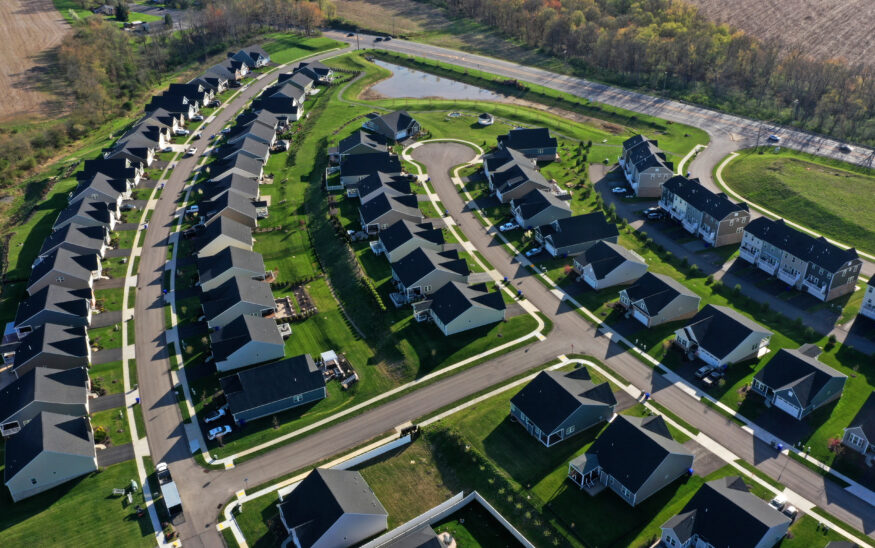
New homes dot the landscape in Middlesex Township, Pa., on April 19, 2023. (AP Photo/Gene J. Puskar, File)
New homes dot the landscape in Middlesex Township, Pa., on April 19, 2023. (AP Photo/Gene J. Puskar, File)
White House 50-year mortgage plan sparks debate
KEN SWEET
AP Business Writer //November 11, 2025//



NEW YORK (AP) — The White House says it is considering backing a 50-year mortgage to help alleviate the home affordability crisis in the country. But the announcement drew immediate criticism from policymakers, social media and economists, who said a 50-year mortgage would do little to resolve other core problems in the housing market, such as a lack of supply and high interest rates.
In Brief:
- The White House is considering a 50-year mortgage to address affordability
- Critics warn it could add hundreds of thousands in extra interest
- Economists say it won’t solve the nation’s housing supply shortage
- Law changes would be required for federal backing of longer loans
Bill Pulte, director of the Federal Housing Finance Agency, said on X over the weekend that a 50-year mortgage would be “a complete game changer” for homebuyers. FHFA is the part of the federal government that oversees Fannie Mae and Freddie Mac, which buy and insure the vast majority of mortgages in the country.
The 30-year mortgage is a uniquely American financial product and the default way to buy a home since the New Deal. Politicians and policymakers at the time wanted to create a standardized mortgage that borrowers could afford and pay off during their working years, when the average lifespan for an American was 66 years old.
Lower payment
Extending the life of a mortgage to 50 years decreases a borrower’s monthly payment.
The average selling price of a home in the U.S. was $415,200 in September, according to the National Association of Realtors. Assuming a standard 10% down payment and an average interest rate of 6.17%, the monthly payment on a 30-year mortgage would be $2,288, while the payment on a 50-year mortgage would be $2,022. That’s presuming a bank would not require a higher interest rate on a 50-year mortgage, due to the longer duration of the loan.
But significantly higher interest
Because even more of the monthly payment on a 50-year mortgage would go toward interest, it would take 30 years for a borrower to accumulate $100,000 in equity, not including home price appreciation and the down payment. That’s compared to 12-13 years to accumulate $100,000 in equity when paying off a 30-year mortgage, excluding the down payment.
A borrower would pay, roughly, an additional $389,000 in interest over the life of a 50-year mortgage compared to a 30-year mortgage, according to an AP analysis.
Other analysts came to a similar conclusion.
“Extending a mortgage from 30 years to 50 years could double the (dollar) amount of interest paid by the homebuyer on a median-priced home over the life of the loan and significantly slow equity accumulation,” wrote John Lovallo with UBS Securities.
Broader housing issues
A 50-year mortgage does nothing to address one critical issue in housing affordability: the lack of housing supply. States like California and cities like New York have recently passed legislation or made regulatory changes to allow builders to build homes faster with less regulatory red tape.
There’s also the raw cost of homebuilding in the country. Products such as steel, lumber, concrete, copper and plastics that go into home construction are now subject to tariffs under President Trump. Further, many construction jobs were being done by undocumented workers, particularly in the Southwest, where deportations are impacting the ability of homebuilders to find enough labor to build homes.
“Many of the big things that would address supply right now are going in the wrong direction,” said Mike Konczal, senior director of policy and research at the Economic Security Project.”
Pulte said on X that introducing a 50-year mortgage was just a “potential weapon,” among other solutions the White House has considered to combat high housing prices.
Americans don’t live long enough
The average age of a first-time homebuyer has been creeping up for years and is now roughly 40 years of age. A 50-year mortgage would be difficult for a bank to underwrite for a 40-year-old first-time homebuyer, who would be 90 years old by the time that home is paid off. The average life expectancy of an American is now roughly 79 years, meaning there are 11 years of life expectancy not covered by a 50-year loan.
“It’s typically not a goal of policymakers to pass on mortgage debt to a borrower’s children,” Konczal said.
Others have tried longer loans
Other parts of the financial system have extended loan terms, with mixed results. The seven-year auto loan has become increasingly common as car prices have risen and Americans keep their cars longer. Despite longer loan terms, auto loan delinquencies have been rising, and the average price of a new car is now $49,740, up from $38,948 five years ago.
Student loans were originally designed to be paid off in 10 years, but now there are multiple repayment options that extend repayment to 20 years.
Economists pointed out that a 50-year mortgage may do the opposite of helping with home affordability by causing home price inflation by introducing more potential buyers into a market struggling with supply.
Trump downplays idea
After significant criticism, President Trump seemed less enthused about the 50-year mortgage. When asked by Laura Ingraham of Fox News about the idea, President Trump said it “might help a little bit” but seemed to brush it off.
Under the Dodd-Frank Act, the mortgage giants Fannie Mae and Freddie Mac cannot insure a mortgage that is longer than 30 years, so any 50-year mortgage would be considered a “non-qualifying mortgage” and would be more difficult to sell to investors. Congress would have to amend U.S. financial laws in multiple places to allow for 50-year mortgages, and there seems to be little appetite for Congress to take this on immediately.