
Upcoming Event
 Free Newsletter

U.S. existing home sales hit nine-month low amid rising mortgage rates
Lucia Mutikani
Reuters //April 13, 2026//
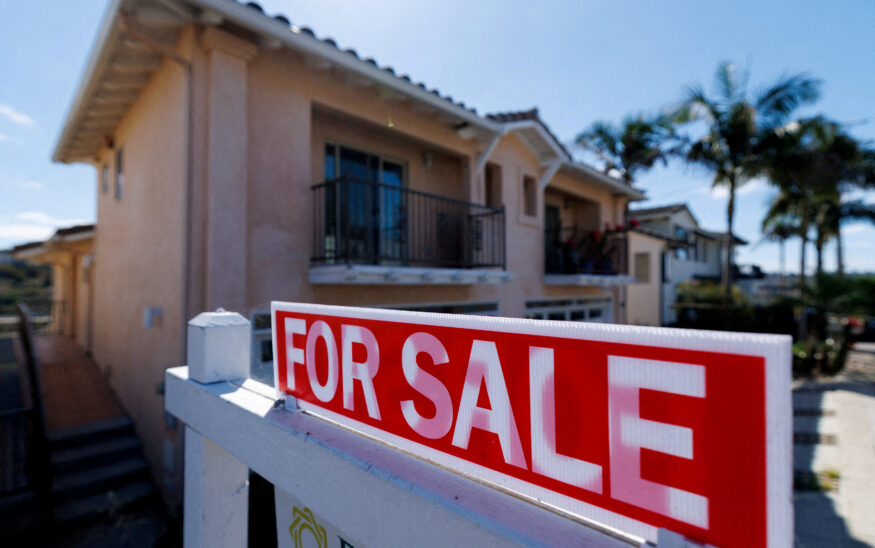
A for sale sign is shown for a residential home in Encinitas, California, U.S. July 25, 2025. REUTERS/Mike Blake//File Photo
A for sale sign is shown for a residential home in Encinitas, California, U.S. July 25, 2025. REUTERS/Mike Blake//File Photo
U.S. existing home sales hit nine-month low amid rising mortgage rates
Lucia Mutikani
Reuters //April 13, 2026//



WASHINGTON (Reuters) – U.S. existing home sales fell to a nine-month low in March amid tight inventory and growing concerns over the labor market, and a recent increase in mortgage rates because of the war with Iran could limit activity this year.
In Brief:
- Existing home sales dropped 3.6% to 3.98 million units in March
- Mortgage rates rose to 6.46% in early April, highest since February
- National Association of Realtors cut 2026 home sales growth forecast to 4%
- Inventory of existing homes increased 3.0% but remains below pre-pandemic levels
The larger-than-expected decline in sales reported by the National Association of Realtors on Monday was despite an improvement in housing affordability at the start of the year. The U.S.-Israeli conflict with Iran, which has boosted gasoline prices and caused a stock market selloff, is undercutting household purchasing power and wealth.
Consumer sentiment has plunged to a record low, a factor the NAR also cited as a constraint on home sales.
“There is little in the near-term backdrop to suggest a quick rebound in sales,” said Daniel Vielhaber, an economist at Nationwide. “We continue to look for sluggish sales this year, particularly in the first half, before a gradual pickup as mortgage rates decline in the second half and into 2027.”
Home sales dropped 3.6% last month to a seasonally adjusted annual rate of 3.980 million units, the lowest level since June 2025. Economists polled by Reuters had forecast home resales easing to 4.06 million units. Existing home sales are counted at the time a contract is closed. Last month’s sales probably reflected contracts signed in January and February, when mortgage rates were falling.
The popular 30-year fixed mortgage rate averaged 5.98% in late February, on the eve of the war, amid expanded purchases of mortgage-backed securities by Freddie Mac and Fannie Mae. It jumped to 6.46% at the start of April and averaged 6.37% last week, according to Freddie Mac data.
Mortgage rates track U.S. Treasury yields, which have risen amid the Middle East conflict, stoking inflation fears. The government reported last week that consumer prices rose the most in nearly 4 years in March.
Sales dropped in all four regions last month. Overall sales decreased 1.0% on a year-over-year basis in March. Sales remained weak in the under-$250,000 price bracket, reflecting an acute shortage of so-called starter homes.
The NAR lowered its home sales growth estimate for 2026 to 4% from a lofty 14%. Its housing affordability index fell to 113.7 in March from 117.5 in February. It was, however, up from 104.2 a year ago.
Lackluster Labor Market: A Constraint
The labor market has been lackluster, with nonfarm payrolls declining in six of the last 15 months. Housing affordability has become a potent political issue ahead of the November midterm elections, with the quintessential American dream of homeownership increasingly out of reach for many.
“Mortgage rates have been rising, and that has led us to trim our home sales outlook for the year,” NAR Chief Economist Lawrence Yun said.
The inventory of existing homes increased 3.0% to 1.36 million units, still remaining well below pre-pandemic levels. Supply was up 2.3% year over year. At March’s sales pace, it would take 4.1 months to exhaust the current inventory of existing homes, up from 4.0 months a year ago.
The decline in supply was in the condominium and cooperative segment of the market, where inventory plunged 29.9% year over year. Single-family housing inventory increased 7.8% year-on-year. Some economists worried about the accuracy of the data.
“We continue to be suspicious of the overall inventories estimate due to another reportedly large decline in condo and coop inventories,” said Michael Gapen, chief economist at Morgan Stanley. “February data had shown similar, but the February drop was revised away in this report, only to reappear in March. We suspect data quality issues rather than a sudden decline in inventories of condos and co-ops.”
With supply still tight, the median existing home price last month increased 1.4% from a year ago to $408,800, the highest for any March. The bulk of the homes sold last month were in the $250,000-$500,000 price range.
The median days on the market for listed properties increased to 41 from 36 a year ago.
First-time buyers accounted for 32% of sales, unchanged from a year ago. Economists and realtors say a 40% share in this category is needed for a robust housing market. All-cash sales constituted 27% of transactions, up from 26% a year ago.
Distressed sales, including foreclosures, made up 2% of transactions, down from 3% a year ago.
“Heading into 2026, the housing market had real momentum — mortgage rates were easing, affordability was improving, and sidelined buyers were starting to reengage,” said Kamini Lane, CEO at Coldwell Banker Realty. “Since then, the market has naturally become more deliberate.”
(Reporting by Lucia Mutikani; Editing by Andrea Ricci)