Upcoming Event
 Free Newsletter

US farm income to fall in 2026 despite government payments
P.J. Huffstutter
Reuters //February 5, 2026//
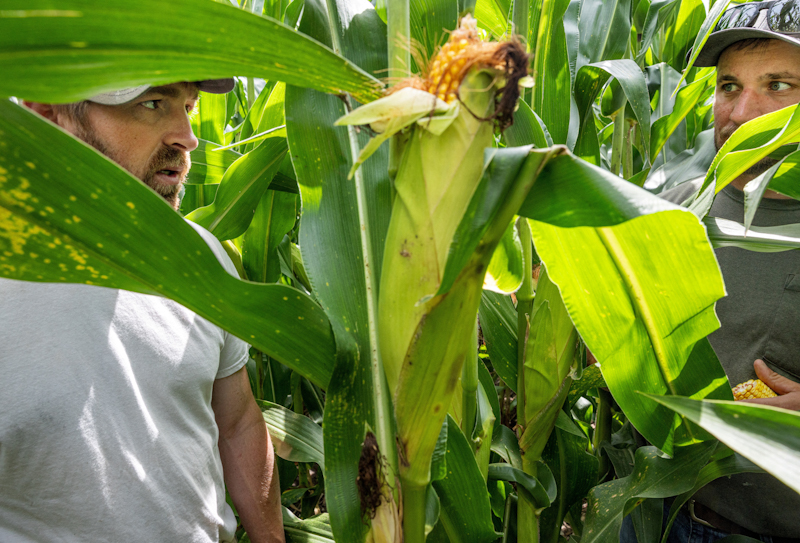
Kyle Wendland checks his corn crop with the local coop agronomist Josh Thiessen, at his farm, Comeback Farms, in Fredericksburg, Iowa, U.S., August 22, 2025. REUTERS/File Photo
Kyle Wendland checks his corn crop with the local coop agronomist Josh Thiessen, at his farm, Comeback Farms, in Fredericksburg, Iowa, U.S., August 22, 2025. REUTERS/File Photo
US farm income to fall in 2026 despite government payments
P.J. Huffstutter
Reuters //February 5, 2026//



CHICAGO (Reuters) – In a sign of growing stress for U.S. farmers, the Agriculture Department forecast on Thursday that U.S. net farm income would fall 0.7% this year, despite near-record government payments that are expected to account for nearly 29% of producers’ bottom line.
In Brief:
- USDA forecasts U.S. net farm income will fall 0.7% to $153.4B in 2026.
- Government payments are expected to make up nearly 29% of farm income.
- Without federal support, farm income would drop nearly 12% to $109.1B.
- Low crop prices, rising costs and trade policies continue to pressure farmers.
Net farm income, a broad measure of profitability in the agricultural economy, is forecast to drop 0.7% to $153.4 billion in 2026 from the year before, USDA said. When adjusted for inflation, net farm income is projected to decrease by $4.1 billion or 2.6%.
Without government payments, net farm income this year would fall nearly 12% to $109.1 billion, according to agency data.
“Government payments are doing a lot of the work in supporting crop producers,” said Wesley Davis, a partner at Meridian Agribusiness Advisors, an agricultural economics consultancy in New York City.
But farmers, economists and lawmakers warn that even more government support may be needed to offset the impact of low crop prices, a global grain glut, rising operational costs and lost export sales due to Trump-era trade and economic policy changes.
Many farmers are increasingly dependent on federal support to pay their bills, while also taking on record levels of debt, even as government payments near record levels, economists said.
USDA forecasts that producers will receive $30.5 billion in direct payment support in 2025 and $44.3 billion in 2026, excluding additional payouts from federal crop insurance indemnities.
Such levels have not been seen since 2020 and 2021 amid the COVID-19 pandemic upheaval and trade disruptions during President Donald Trump’s first term.
On Thursday, USDA said the higher support figures reflect payments from Farm Bill programs triggered by falling crop prices, along with continued high levels of supplemental and disaster assistance.
The data, which is published three times a year, was not released in December due to an earlier federal government shutdown, and those findings were incorporated into the regular February report. Agricultural economists said that the delay has made it harder to assess stress in the sector.
USDA forecast that farmers’ cash receipts, what they get paid for their crops, would rise this year for corn, hold generally steady for soybeans, and fall for wheat. Livestock receipts are expected to drop due mainly to lower egg and milk prices, while cattle receipts will continue to increase.
The chair of the U.S. Senate’s agriculture committee said on Tuesday that many farmers were suffering heavy losses, while more than two dozen former USDA officials and industry leaders cautioned lawmakers that U.S. agriculture faced the risk of a “widespread collapse” in part because of the Trump administration’s policies.
(Reporting by P.J. Huffstutter; Editing by Cynthia Osterman)
g